












Japan is consistently ranked as one of the safest countries in the world. With its low crime rate, clean streets, and incredibly helpful locals, it’s easy to let your guard down and simply enjoy the neon lights of Tokyo or the serene temples of Kyoto. However, no destination is immune to emergencies. From sudden earthquakes and medical issues to simply losing your passport, being prepared is the key to turning a potential crisis into a manageable situation.
For tourists, the language barrier can make even a minor incident feel overwhelming. Knowing who to call, what to say, and where to go can make all the difference. This comprehensive guide covers everything you need to know about emergency numbers in Japan, essential Japanese phrases for safety, and how to navigate the country’s unique disaster preparedness systems.
Bookmark this page now—hopefully, you’ll never need it, but if you do, it will be the most valuable resource on your phone.
Critical Emergency Numbers in Japan (110, 119)
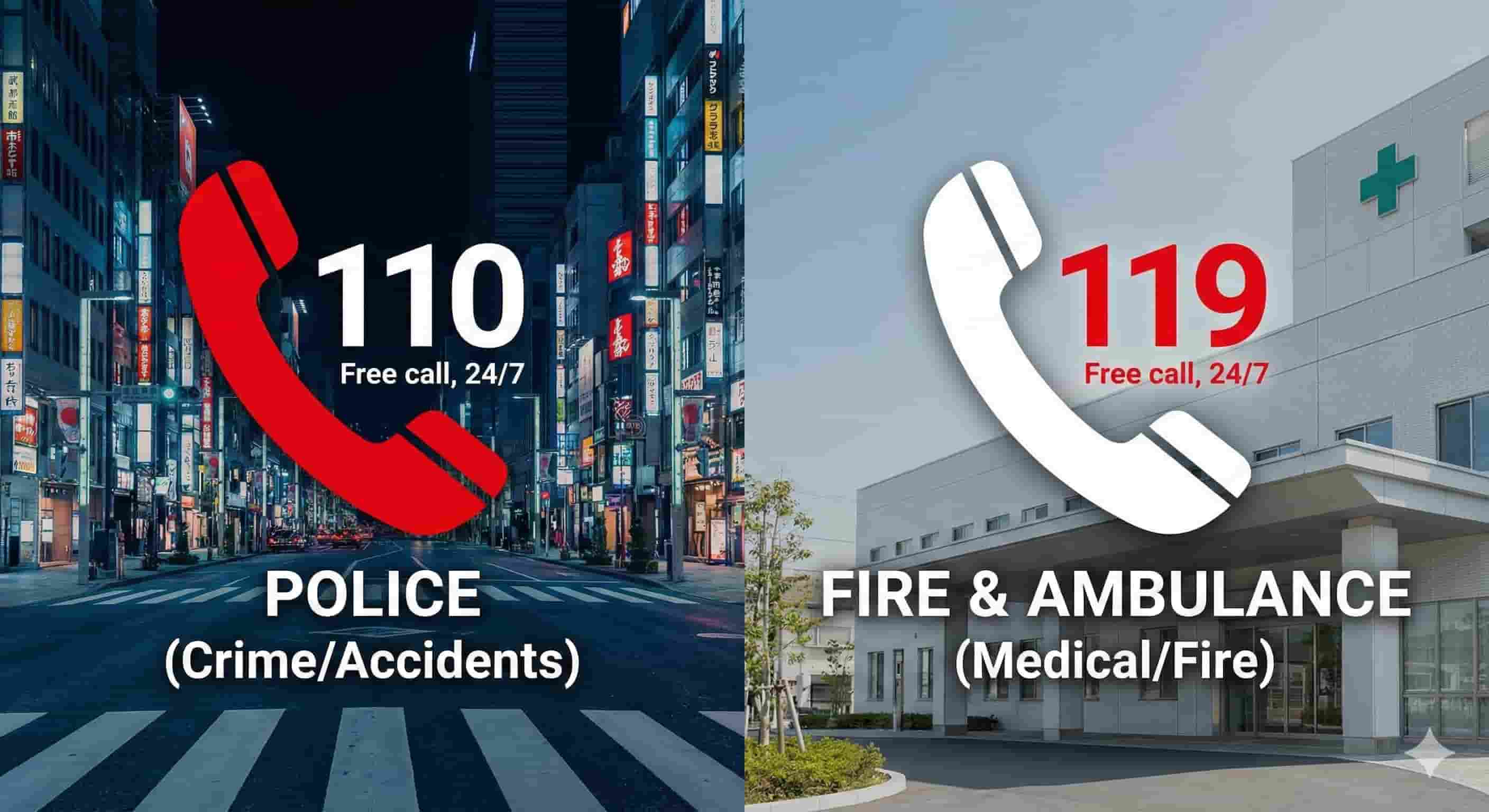
In Japan, emergency services are efficient and reliable. Unlike the US or UK where a single number (911 or 999) covers everything, Japan splits its emergency services into two main direct lines.
1. Police: Dial 110
- When to call: If you are involved in or witness a crime, a traffic accident, or a serious altercation.
- What happens: You will be connected to a police dispatch center.
- Language Support: In major cities like Tokyo and Osaka, there are often English-speaking staff available, or they can patch in a translator.
- Cost: Free from any phone (including public payphones).
2. Fire & Ambulance: Dial 119
- When to call: For fires, medical emergencies, or serious injuries requiring immediate transport to a hospital.
- What to say: The operator will ask “Fire or Ambulance?” ( Kaji desu ka? Kyu-kyu desu ka? ).
- Ambulance: Say “Kyu-kyu desu” (Queue-queue dess).
- Fire: Say “Kaji desu” (Kah-jee dess).
- Important Note: Ambulances in Japan are free to call and use for transport, but medical treatment at the hospital is not free. Ensure you have valid travel insurance before your trip.
3. Coast Guard: Dial 118
- When to call: If you witness an accident at sea or a drowning incident while visiting Japan’s coastal areas or beaches.
How to Use Public Phones for Emergencies
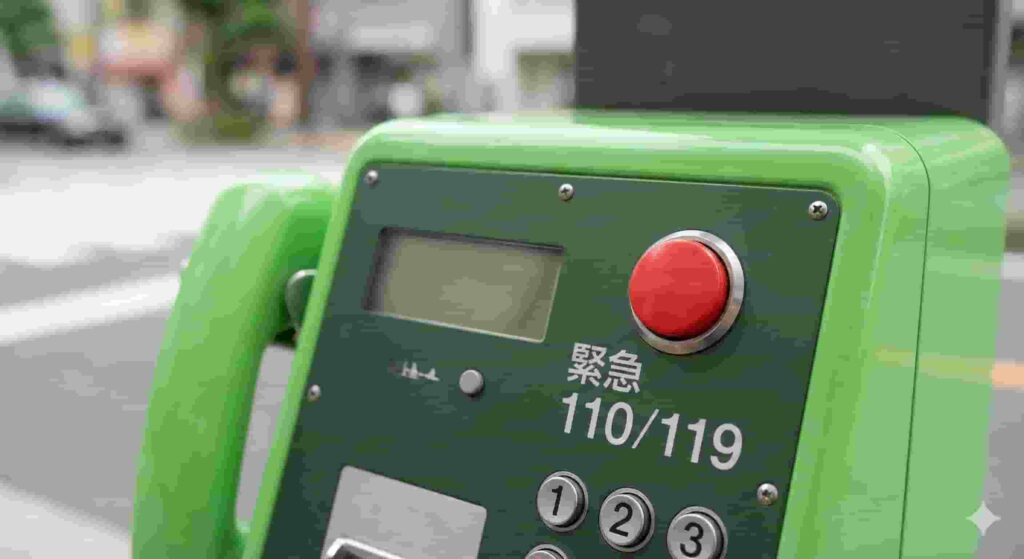
If your mobile battery dies, look for a green or gray public phone.
- Lift the receiver.
- Press the red emergency button (usually located on the front panel).
- Dial 110 or 119.
- The call is free; no coins or cards are needed.
The Japan Visitor Hotline & Non-Emergency Support
Sometimes you have a serious problem that isn’t life-threatening, such as a lost wallet, a minor illness, or confusion about a safety alert. In these cases, avoid clogging the 110/119 lines and use these dedicated resources instead.
Japan Visitor Hotline: 050-3816-2787
Operated by the Japan National Tourism Organization (JNTO), this is the “gold standard” helpline for tourists.
- Hours: Available 24 hours a day, 365 days a year.
- Languages: English, Chinese, Korean, and Japanese.
- Use this for: Assistance with accidents, illness, natural disasters, and general tourism-related emergencies. If you aren’t sure who to call, call here first.
Police Consultation: #9110
If you want to report a non-urgent issue to the police (like a noise complaint, a lost item that isn’t theft, or a neighborhood dispute), dial #9110. This connects you to the police consultation center rather than the emergency dispatch.
Essential Japanese Emergency Phrases
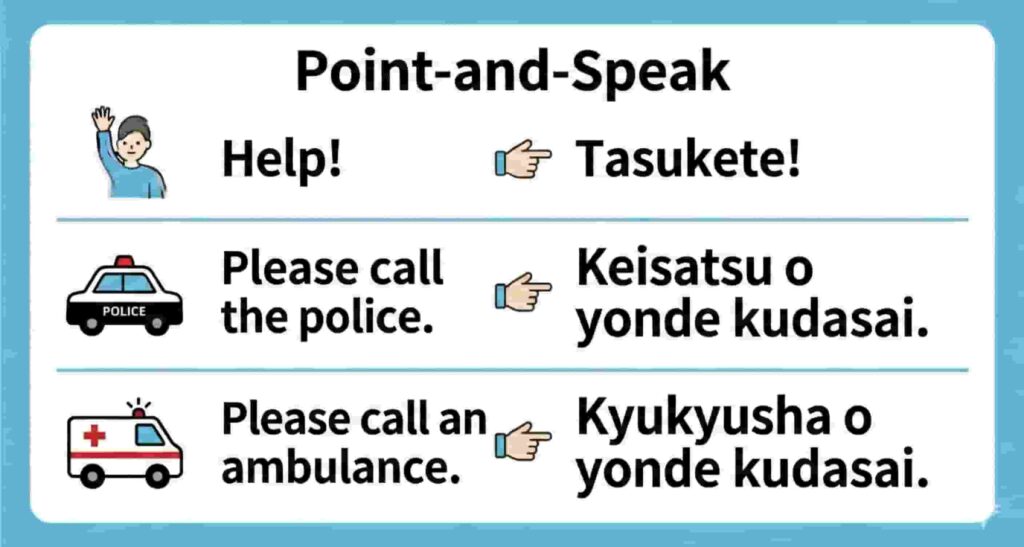
Even if the operator speaks English, being able to shout a key phrase to a passerby can get you help faster. Japanese locals are very helpful but may be shy about their English skills. Speaking a few words of Japanese signals the urgency of the situation.
General Help
- Help!
- Tasukete! (Tah-skeh-teh!)
- Please call the police.
- Keisatsu o yonde kudasai. (Kay-sat-soo oh yon-deh koo-dah-sigh)
- Please call an ambulance.
- Kyukyusha o yonde kudasai. (Queue-queue-shah oh yon-deh koo-dah-sigh)
- I don’t speak Japanese.
- Nihongo ga wakarimasen. (Nee-hon-go gah wah-kah-ree-mah-sen)
- Is there someone who speaks English?
- Eigo o hanaseru hito wa imasu ka? (Ay-go oh ha-nah-seh-roo hee-to wah ee-mass kah?)
Medical Situations
- I am injured.
- Kega o shimashita. (Keh-gah oh she-mash-ta)
- I feel sick.
- Kibun ga warui desu. (Key-boon gah wah-rue-ee dess)
- It hurts here. (Point to body part)
- Koko ga itai desu. (Ko-ko gah ee-tie dess)
- I have a fever.
- Netsu ga arimasu. (Net-soo gah ah-ree-mass)
Disaster Phrases
- Earthquake!
- Jishin da! (Jee-sheen dah!)
- Is it safe here?
- Koko wa anzen desu ka? (Ko-ko wah an-zen dess kah?)
- Where is the evacuation area?
- Hinan-basho wa doko desu ka? (Hee-nan ba-show wah doh-ko dess kah?)
Handling Natural Disasters: Earthquakes & Tsunamis
Japan is an earthquake-prone country. While the infrastructure is built to withstand strong tremors, it can be terrifying if you aren’t used to it.
What to Do During an Earthquake
- Drop, Cover, and Hold On: If you are indoors, get under a sturdy table. Do not run outside immediately, as falling glass and tiles are major hazards.
- Stay Calm: Most earthquakes in Japan are minor. Wait for the shaking to stop.
- Check for Tsunami Warnings: If you are near the coast, this is your priority.
- Follow Locals: If everyone in the train station stops or evacuates, do exactly what they do.
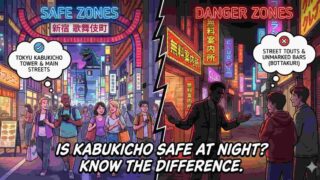
Travel Tip: For specific safety advice in busy nightlife districts during emergencies, read our guide on Don’t Go to Kabukicho Alone: 5 Safety Rules for Tourists & Warning Zones.
Understanding Tsunami Warnings
If you are near the ocean and feel a strong quake, do not wait for a siren. Move to higher ground immediately. Look for green and white signs that say “Tsunami Evacuation Area”.
- Note: A Tsunami Advisory (1m or less) means stay out of the water. A Tsunami Warning (up to 3m) or Major Warning (over 3m) means evacuate inland and to high ground immediately.
Must-Download Safety Apps
Before you fly, download these apps. They push English notifications about quakes and warnings to your phone faster than you can find them on the news.
- Safety tips (by JNTO): The official app for tourists. Provides disaster alerts and communication cards.
- NERV Disaster Prevention: Highly rated, incredibly fast, and detailed earthquake/tsunami info in English.
- Google Maps: Offers evacuation route features during disasters.
Medical Emergencies & Finding a Doctor
Getting sick in a foreign country is stressful. In Japan, you cannot just walk into any hospital; some are referral-only, and many local clinics do not have English support.
Finding an English-Speaking Doctor
- Himawari (Tokyo Health/Medical Information Service): If you are in Tokyo, this service helps you find hospitals with foreign language staff.
- Ask Your Hotel: Concierges often have a list of “foreigner-friendly” clinics nearby.
- AMDA International Medical Information Center: A non-profit that provides telephone interpretation and medical referrals.
Pharmacies & Medicine
Japanese drugstores (look for the kanji 薬 or signs like “Matsumoto Kiyoshi”) sell over-the-counter medicine. However, packaging is in Japanese.
- Use Google Lens to translate box labels instantly.
- Painkiller: Ask for Chintsu-zai (Seddes and EVE are popular brands).
- Cold Medicine: Ask for Kaze-gusuri (Pabron is a common brand).
The Koban System: Your Neighborhood Safety Hub

You will see small, glass-fronted buildings near almost every major train station and intersection. These are Koban (Police Boxes).
- What they are: Community police stations staffed 24/7 (in cities) by uniformed officers.
- What they do:
- Directions: If you are lost, they have detailed maps and are happy to help. This is useful if you are navigating complex areas; check our Shinjuku Station Survival Guide: How to Find Your Exit in the World’s Busiest Hub to see why you might need help!
- Lost & Found: If you lose your wallet or passport, go here immediately.
- Crime Reporting: Report thefts or disputes here.
The Koban is a symbol of Japanese safety. Don’t be afraid to approach them if you need assistance.
Lost & Found Procedures
Japan is famous for its honesty. If you lose your wallet on a train, there is a very high probability it will be turned in with the cash still inside.
- Retrace Your Steps: Go back to the shop or station where you last had it.
- Contact the Train Line: If lost on a train, go to the “Lost & Found” counter at the terminal station of that line. You may need your transport card details—learn more in our guide: The Ultimate Guide to Buying a Suica or Pasmo Card.
- File a Report at a Koban: If the item isn’t found immediately, fill out a Ishitsubutsu-todoke (Lost Property Report) at the nearest police box. You will need to describe the item in detail.
Conclusion
Japan is a welcoming and safe destination, but being prepared for the unexpected allows you to travel with true peace of mind. By saving the emergency numbers 110 and 119, downloading the NERV or Safety tips app, and learning a few key phrases like “Tasukete” and “Kyu-kyu-sha”, you are protecting yourself and your travel companions.
Remember, the best response to an emergency is a calm one. Japan’s systems are designed to help you—you just need to know how to access them.
Next Step
Don’t wait until you arrive! Screenshot this article or copy the key numbers into your phone’s contacts right now. For more tips on navigating Japanese culture and staying “street smart,” check out our Tips & Manners section for essential advice before you fly.
Stay safe, and enjoy your trip to Japan!