











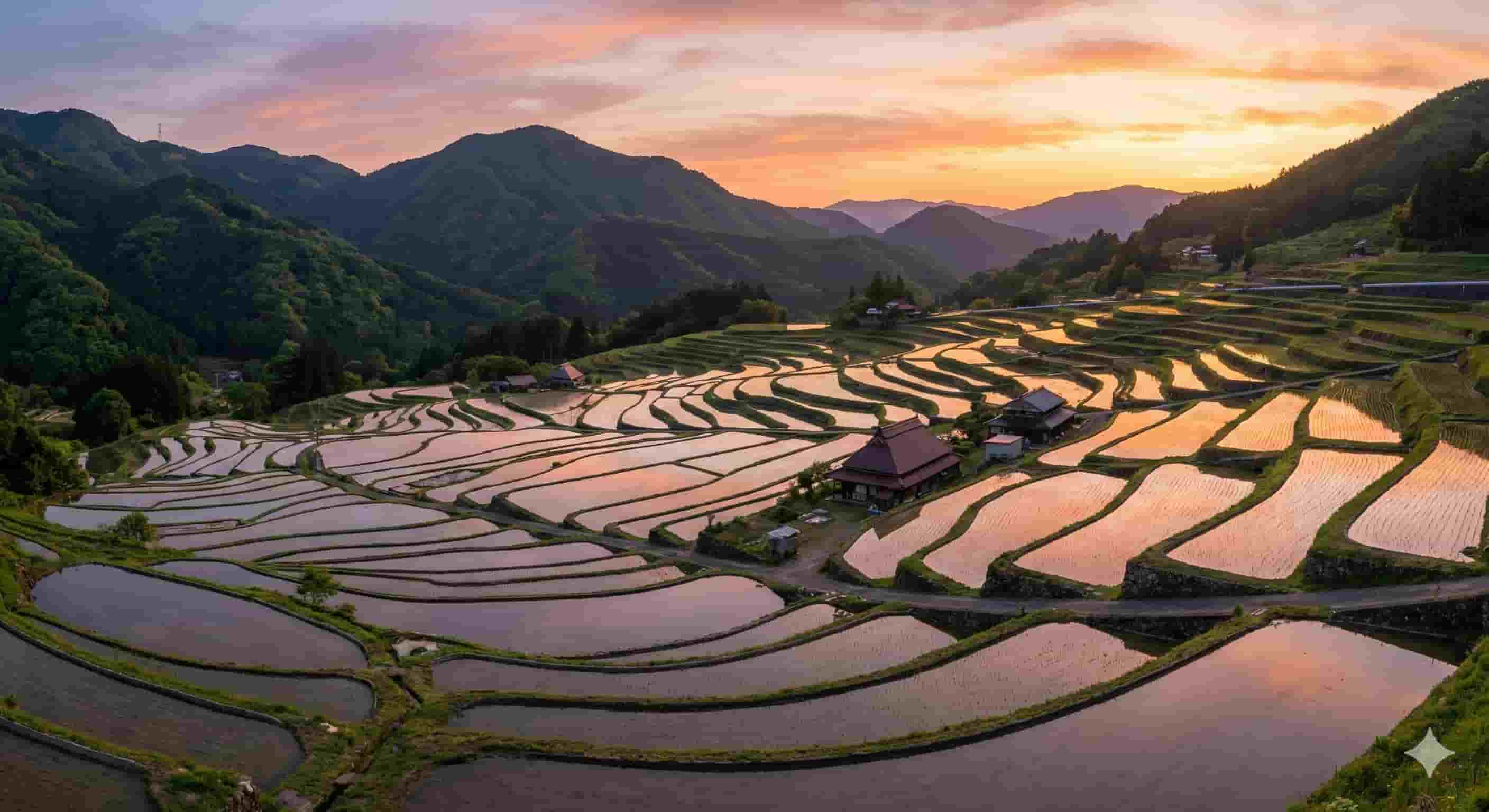
While the cherry blossoms (sakura) capture the world’s attention in early April, a far more profound and reflective transformation is taking place in the Japanese countryside. As the petals fall, the rice paddies flood.
For the elite traveler and the keen photographer, the period from mid-April to late May offers Japan’s most spectacular “Green Views”: the season of Tanada (rice terraces).
This is not merely about agriculture; it is a spiritual landscape. The sight of water-filled terraces reflecting the sky—known as Mizukagami (Water Mirror)—is a fleeting masterpiece of nature and human ingenuity. In this comprehensive guide, we will journey beyond the guidebooks to explore the deep cultural significance of rice in Japan, the magic of the planting season, and the top five breathtaking rice terrace locations you must visit.
Planning the rest of your trip? This article is just one part of the season. To get the full picture—including the 2026 Cherry Blossom Forecast, Golden Week survival tips, and Skiing advice—check out my main guide:
👉 Read the Ultimate Guide to Spring in Japan 2026
The Soul of a Nation: Why Rice Means More Than Food to the Japanese
To view a rice field in Japan is to look at the very foundation of the country’s identity. For the Japanese people, rice (kome) holds a special significance that transcends its role as a staple food. It is the heartbeat of history, economy, and spirituality.
A Foundation of Culture and History
Rice cultivation arrived in Japan approximately 3,000 years ago, acting as the catalyst for the formation of the nation. It was the mechanism that transitioned society from hunter-gatherers to settled communities. Historically, rice was far more than a crop; it was currency.
- The Tax System: For centuries, taxes (nengu) were paid in rice, not coin.
- The Economic Measure: The wealth of feudal lords (Daimyo) was measured in koku—a unit of volume representing the amount of rice required to feed one person for a year. The “Kokudaka” system determined political power based entirely on rice production capacity.
The Divine Connection: Shinto and Agriculture
You cannot separate Japanese spirituality from the paddy. Rice cultivation is deeply intertwined with Shinto, Japan’s indigenous religion. The process of growing rice is seen as a ritual of prayer.
- Imperial Rituals: Even today, His Majesty the Emperor personally plants rice seedlings within the Imperial Palace grounds every spring and harvests them in autumn.
- Niinamesai: The “Festival of New Tasting” is one of the most important Shinto rituals, where the Emperor offers the newly harvested rice to the gods and tastes it himself to express gratitude.
- The Power of Kanji: The Japanese character for rice (米) is said to be derived from the characters for “eighty-eight” (八十八). This signifies the 88 painstaking steps required by farmers to produce the grain. It is taught that seven gods reside in a single grain of rice, fostering a culture of profound respect and zero waste.
Shaping the Landscape and Community
The physical landscape of Japan—70% mountainous—is ill-suited for large-scale farming. The solution was the Tanada (terraced paddy). Carving flat surfaces into steep mountainsides required immense communal effort.
This necessity created the concept of Yui (collaborative labor). Water management in rice paddies requires strict cooperation; one selfish act could ruin a neighbor’s crop. This agricultural necessity birthed the Japanese values of harmony (wa), cooperation, and strong community bonds. When you look at a rice terrace, you are looking at centuries of community cohesion.
The Magic of Spring: The “Mizukagami” Phenomenon
Why visit Japanese rice terraces in spring? Because it is the only time of year you can witness the Mizukagami (Water Mirror).
Between mid-April and late May, just before the seedlings grow tall, the paddies are flooded with water.
- The Mirror Effect: The terraces transform into thousands of geometric mirrors. They reflect the blue sky, the shifting clouds, and the surrounding mountains.
- Twilight Beauty: The most coveted time for photographers is sunset. The water catches the gradient of the twilight sky—burning oranges, deep purples, and indigo—creating a surreal, stained-glass effect on the side of the mountain.
- The Breath of Life: After the silence of winter, the water brings the landscape back to life. Frogs begin to sing, water striders skate across the surface, and the orderly rows of young green seedlings (sanae) represent the hope of a bountiful harvest.
Top 5 Breathtaking Spring Rice Terrace Spots in Japan
Based on expert curation and the “Green Views” selection, here are the five most spectacular locations to experience the Japanese spring.
1. Maruyama Senmaida (Mie Prefecture)
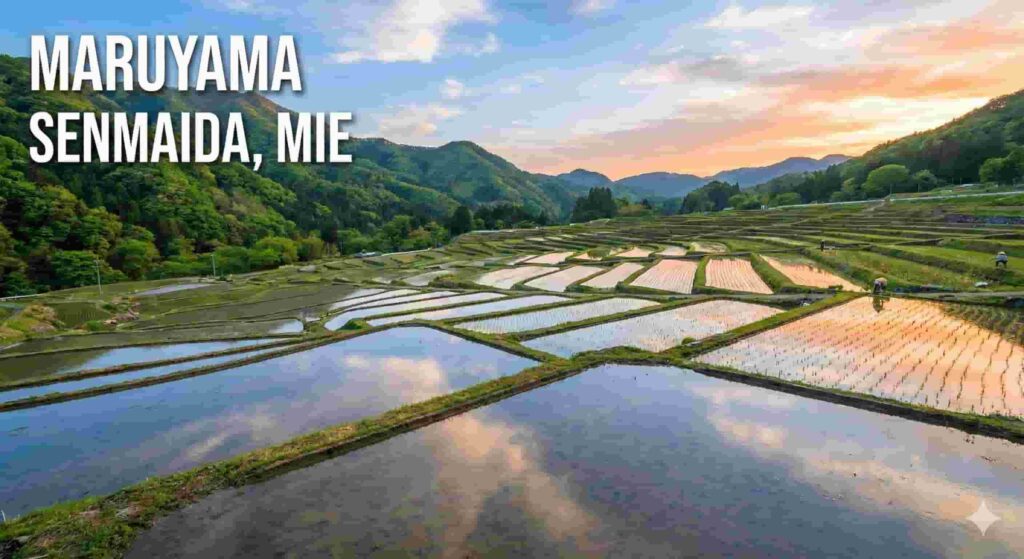
The Scale of History
- Location: Kiwa-cho, Kumano City, Mie Prefecture
- Best Time to Visit: Mid-April to Late May
- Access: Approx. 1 hour 50 minutes by car from Nanki Shirahama Airport.
Why It Ranks First: Maruyama Senmaida is often cited as the jewel of Japanese agricultural landscapes. It is one of the largest continuous sets of rice terraces in Japan, boasting approximately 1,340 small paddies carved into the slope.
The density here is staggering. There is a local saying: “If you think one paddy is missing, look under your straw hat.” The fields are so small and intricate that a single hat could hide one.
The Experience: During the spring, the water-filled paddies reflect the moon and the stars, creating a celestial connection between the earth and sky. This area is situated near the Kumano Kodo, a UNESCO World Heritage pilgrimage route. The preservation of this landscape is a testament to the local preservation society, making it a living museum of Japanese heritage.
Pro Tip: View the terraces from the observation deck at the top, or hike the Tori-toge pass on the Iseji route for a panoramic view that looks like a dragon scaling the mountain.
2. Hamanoura Rice Terraces (Saga Prefecture)
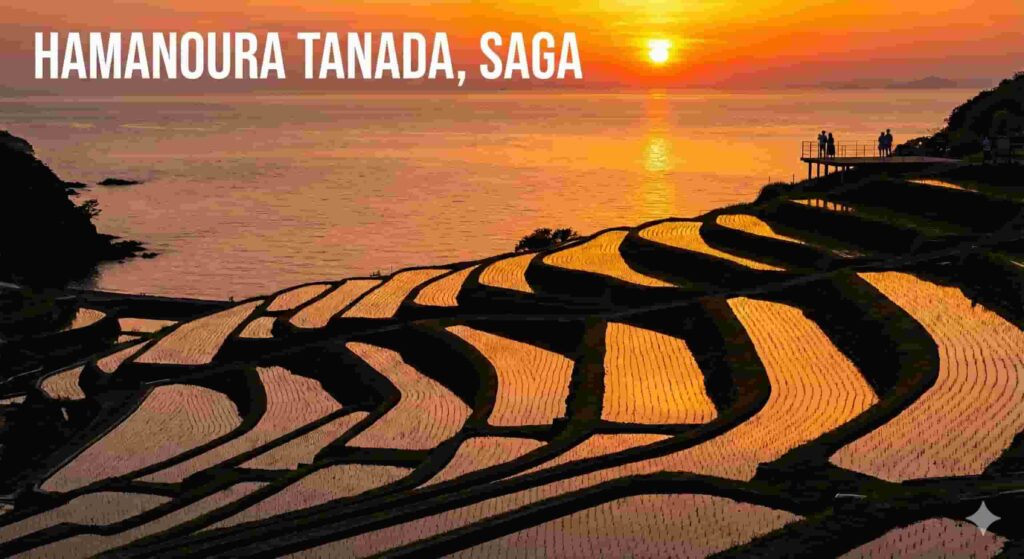
The Sunset Sanctuary
- Location: Genkai-cho, Higashimatsuura District, Saga Prefecture
- Best Time to Visit: Mid-April to Early May
- Access: Approx. 1 hour 30 minutes by car from Fukuoka Airport.
Why It Ranks First for Romance: Located on a coastal inlet facing the Genkai Sea, the Hamanoura terraces rise from the shore like a stairway to heaven. This location is officially designated as a “Lover’s Sanctuary,” and for good reason.
The Experience: This spot is fundamentally different from mountain terraces because of the ocean backdrop. During the planting season, the setting sun aligns perfectly with the inlet. The water in the paddies turns a brilliant orange, contrasting with the silhouetted ridges of the footpaths (aze). The geometric patterns against the vastness of the ocean create a visual drama that attracts photographers from around the globe.
Pro Tip: Arrive at least an hour before sunset to secure a spot at the observation deck, as this is a highly popular location for photographers during Golden Week.
3. Aragijima (Wakayama Prefecture)
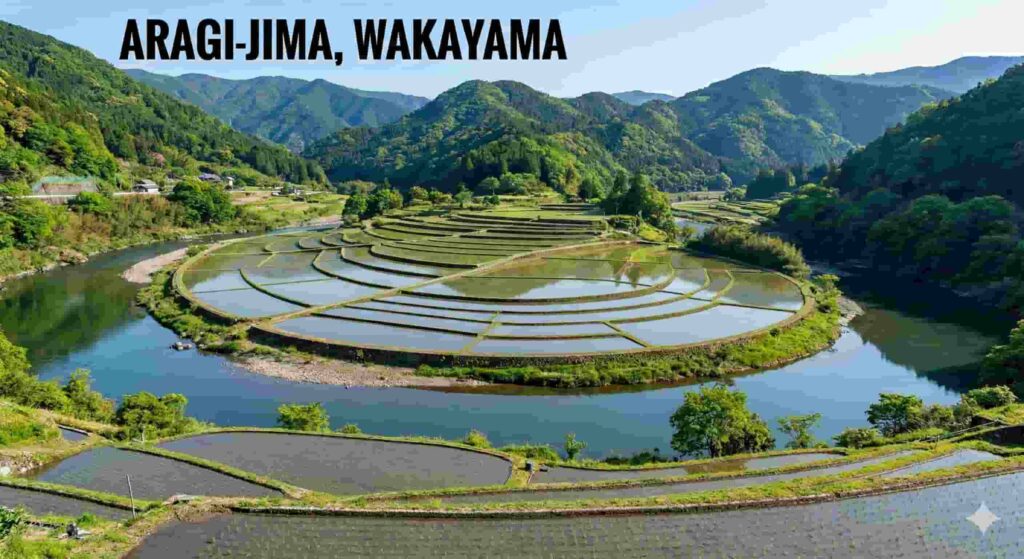
The Geometric Wonder
- Location: Shimizu, Aridagawa-cho, Wakayama Prefecture
- Best Time to Visit: Spring for reflections; Summer for lush green.
- Access: Approx. 1 hour 40 minutes by car from Kansai International Airport (KIX).
Why It Ranks First for Uniqueness: Aragijima is not your typical “step-style” terrace. It is a fan-shaped rice field located on a river terrace formed by the meandering Arida River, which curves in a distinct Ω (Omega) shape.
The Experience: Selected as one of Japan’s “Top 100 Terraced Rice Fields” and a vital cultural landscape, Aragijima looks like a mosaic art piece dropped into the valley. In spring, the water-filled fields shimmer like stained glass. It is a testament to how Japanese farmers adapted to even the most eccentric geological formations to cultivate rice.
Pro Tip: There is a designated observation deck on the opposite side of the river that offers the perfect bird’s-eye view of the fan shape.
4. Ogi Tanada (Kumamoto Prefecture)
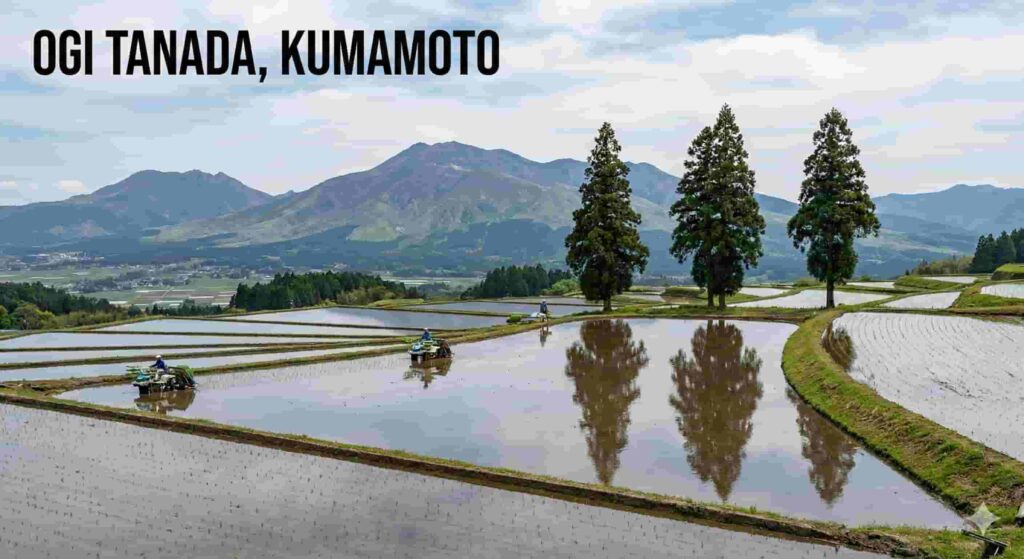
The Alpine Landscape
- Location: Ubuyama Village, Aso District, Kumamoto Prefecture
- Best Time to Visit: May
- Access: Approx. 1 hour 20 minutes by car from Aso Kumamoto Airport.
Why It Ranks First for Landscape Composition: Nestled in the Aso caldera region, Ogi Tanada sits at an altitude of 800 meters. The backdrop is the majestic Kuju Mountain Range, providing a dramatic alpine atmosphere that differs significantly from coastal or valley terraces.
The Experience: The unique feature of Ogi Tanada is the “Three Cedars” (Sanbonsugi) standing alone in the fields. These trees provide a perfect focal point for photographers and aid in composition. When the water mirrors the sky in spring, the reflection of the three cedars and the smoking volcanoes in the distance creates a scene of mystical tranquility.
Pro Tip: The water here is sourced from mountain springs, known for their purity. The rice grown here is exceptionally delicious due to the temperature difference between day and night in the highlands.
5. Tashibunoshou (Oita Prefecture)
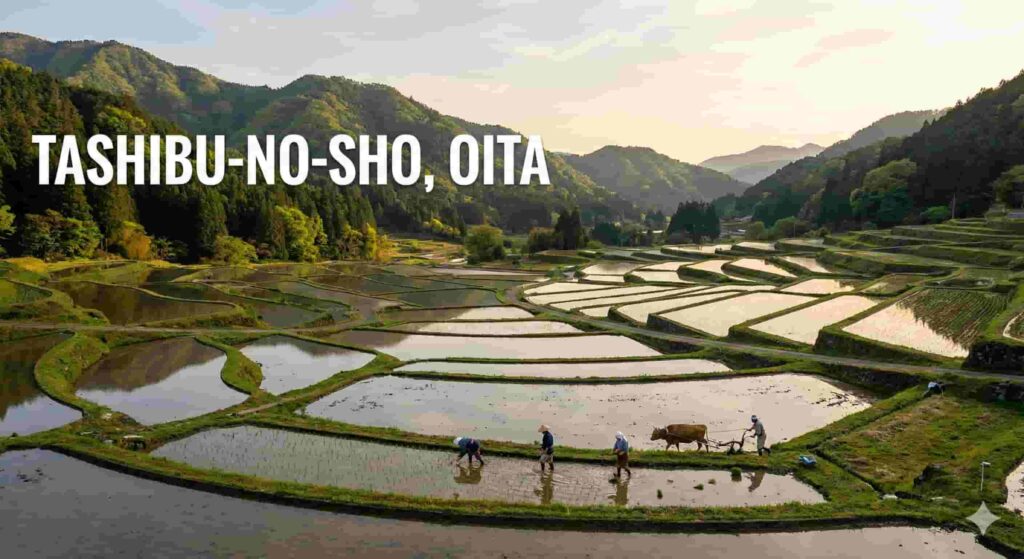
The Medieval Time Capsule
- Location: Tashibu, Bungotakada City, Oita Prefecture
- Best Time to Visit: Late spring (May) or Autumn
- Access: Approx. 50-80 minutes by car from Oita Airport.
Why It Ranks First for History: Tashibunoshou is a landscape frozen in time. Located on the Kunisaki Peninsula—a region known for the syncretism of Shinto and Buddhism—this area retains the exact layout of a rural estate (Shoen) from the Heian Period (794–1185).
The Experience: Recognized as a Globally Important Agricultural Heritage System (GIAHS), the irregularly shaped paddies fit together like a complex puzzle in the valley. Walking here feels like stepping onto a movie set of ancient Japan. In spring, the western sun hits the water-filled fields, illuminating a landscape that has produced rice for the gods for over 1,200 years.
Pro Tip: Combine this visit with a trip to the nearby Usa Jingu Shrine or the rock-carved Buddhas of Usuki to fully understand the spiritual history of the Kunisaki Peninsula.
Practical Tips for Visiting Rice Terraces
Visiting these rural locations requires different planning than a trip to Tokyo or Osaka.
1. Transportation is Key
Most Tanada are located in deep rural areas inaccessible by train.
- Rent a Car: This is almost mandatory. Japan’s navigation systems are excellent (ask for an English GPS). Driving in rural Japan is generally stress-free compared to the cities.
- Check out our Guide to Driving in Rural Japan for tips on International Driving Permits and tolls.
2. Respect the Local Etiquette
This is the most critical advice. Rice terraces are not public parks; they are private farms.
- Do not enter the paddies: Never step onto the ridges (aze) or into the water. You can damage the crops or the irrigation structure.
- Greetings: If you see a farmer, say “Konnichiwa” (Hello). A little respect goes a long way.
- Don’t block the road: Park only in designated areas. Farm trucks need access at all times.
3. Photography Gear
To capture the Mizukagami effect:
- Circular Polarizer (CPL) Filter: Essential for managing reflections on the water and deepening the blue of the sky.
- Tripod: Necessary for low-light sunset shots, but ensure it doesn’t obstruct farm paths.
- Wide Angle Lens: To capture the scale of terraces like Maruyama Senmaida.
Conclusion: The View That Feeds the Soul
The rice terraces of Japan offer more than just a pretty picture. They are a testament to the resilience of the Japanese people and their ability to live in harmony with nature. When you stand before the mirror-like waters of Maruyama or the sunset-drenched coast of Hamanoura, you are witnessing a landscape that has been carefully tended to by human hands for millennia.
In a modern world that moves at breakneck speed, a trip to these “Green Views” invites you to slow down, breathe the clean air, and appreciate the roots of Japanese culture.
Are you ready to witness the real Japan?
Next Step
Beautiful scenery isn’t limited to Japan’s rice paddies! A thorough guide to Japan’s world-renowned cherry blossoms!!
Best Cherry Blossom Spots in Japan: A Journey Through Pink Petals and History