















If you have ever stepped into a traditional Japanese restaurant or walked the streets of Tokyo, you have likely faced the delicious dilemma: Soba vs. Udon.
To the uninitiated, they might just look like “noodles in broth.” But to mistake one for the other is to miss centuries of culinary craftsmanship, distinct regional rivalries, and vastly different nutritional profiles. Whether you are a health-conscious eater looking for complex carbohydrates, a home cook trying to perfect a stir-fry, or a traveler wanting to order like a local, understanding the difference between soba and udon is essential.
In this comprehensive guide, we move beyond the basics. We will explore the molecular structure of the dough, the cultural etiquette of the “slurp,” the regional broth wars between East and West Japan, and strictly evaluate which noodle reigns supreme for your diet.
you might like,,,
Top 10 Hidden Ramen Shops in Tokyo: The Ultimate Guide to Secret Bowls & Local Legends
How to Order Ramen Like a Pro: The Scary Ticket Machine Explained
- 1. The Core Distinction: Buckwheat vs. Wheat
- 2. Texture Wars: The “Snap” vs. The “Chew”
- 3. Nutritional Showdown: Which is Healthier?
- 4. Regional Rivals: Kanto (East) vs. Kansai (West)
- 5. Popular Dishes: How to Order Like a Pro
- 6. How to Cook Soba and Udon at Home
- 7. Dining Etiquette: The Art of the Slurp
- 8. Conclusion: Which Noodle Reigns Supreme?
1. The Core Distinction: Buckwheat vs. Wheat
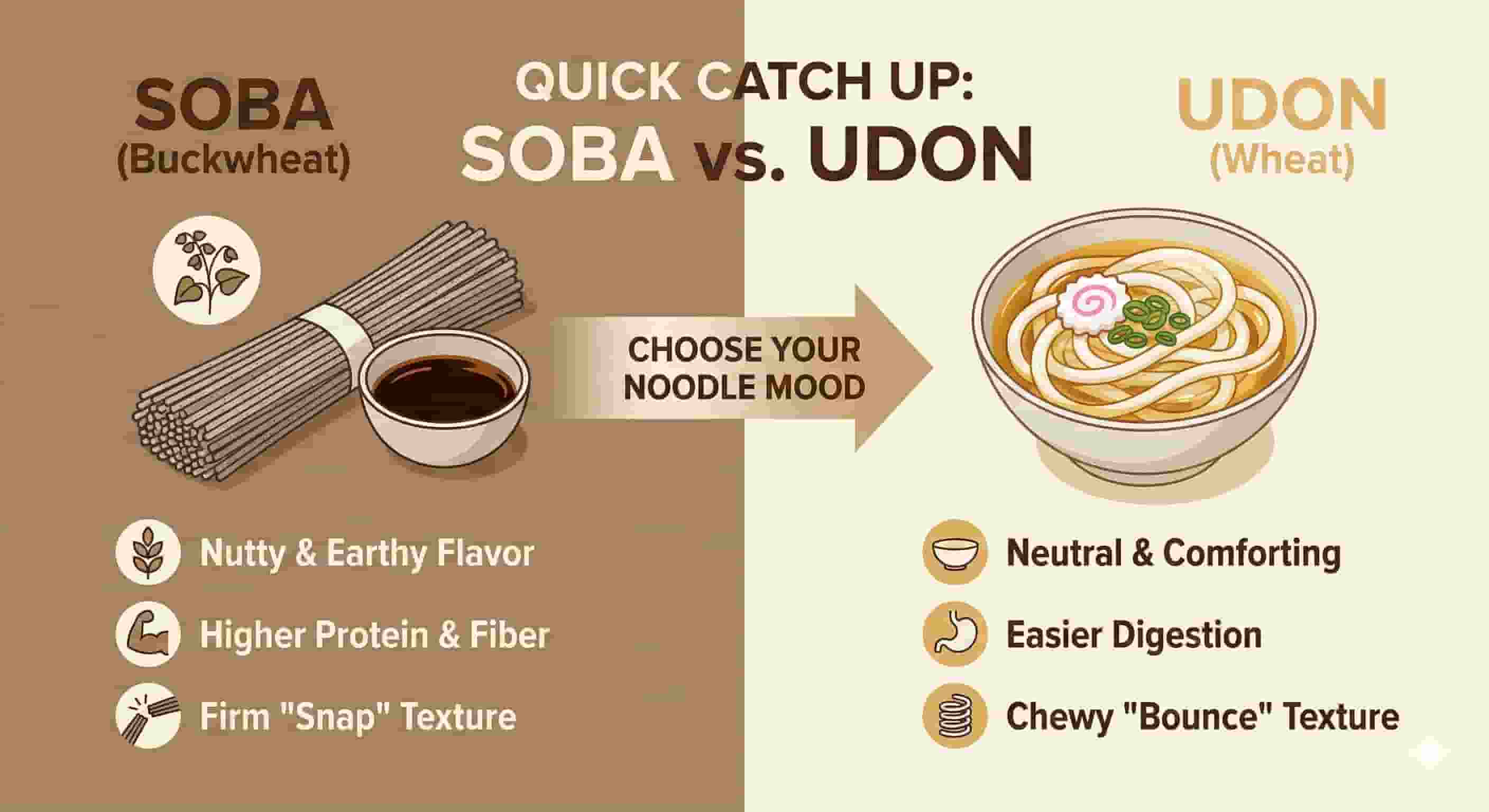
The fundamental difference between these two giants of Japanese cuisine lies in their DNA: the flour used to create them. This single ingredient dictates everything from the noodle’s color and texture to its aroma and nutritional density.

Soba: The Nutty, Complex Buckwheat Noodle
Soba (そば) is the Japanese word for buckwheat. Despite the name, buckwheat is not a type of wheat; it is a pseudo-cereal seed related to rhubarb and sorrel.
- Appearance: Thin, distinct strands roughly the size of spaghetti. The color ranges from light beige to dark gray-brown, often with visible speckles of grain.
- Primary Ingredient: Buckwheat flour (sobako). However, because 100% buckwheat is brittle and difficult to work with, it is often blended with a small amount of wheat flour as a binder.
- Flavor Profile: Nutty, earthy, robust, and aromatic. High-quality soba has a scent reminiscent of fresh grain or hay.
Udon: The Chewy, Comforting Wheat Giant
Udon (うどん) is the ultimate comfort food, made from refined wheat flour (komugiko), salt, and water.
- Appearance: Thick, glossy, white noodles. They are significantly thicker than soba, ranging from 4mm to 6mm in diameter.
- Primary Ingredient: Wheat flour. The magic of udon lies in the kneading process, which develops gluten to create its signature texture.
- Flavor Profile: Neutral, subtle, and slightly salty. Udon is a vehicle for flavor, designed to absorb the characteristics of the dashi (soup stock) and toppings it is served with.
Key Takeaway: If you want a noodle with its own distinct flavor, choose Soba. If you want a chewy texture that carries the flavor of a soup, choose Udon.
2. Texture Wars: The “Snap” vs. The “Chew”
When discussing soba vs. udon noodles, texture is the battlefield where preferences are cemented.

Soba Texture: The Al Dente “Snap”
Soba should never be mushy. A properly cooked soba noodle offers a firm, slightly grainy texture. Because buckwheat lacks gluten, the structural integrity of the noodle is delicate.
- The Experience: When you bite into soba, particularly cold Zaru Soba, there should be a clean break or “snap.”
- Ju-warisoba (100% Buckwheat): This is the holy grail for purists. It has a rougher, grainier texture and breaks easily, but offers the most intense aroma.
- Ni-hachi (2:8 Ratio): The most common style, consisting of 20% wheat and 80% buckwheat. This blend offers the perfect balance of soba flavor and smooth slurping texture.
Udon Texture: The “Mochi-Mochi” Bounce
Udon is all about mouthfeel. In Japan, the texture of udon is described as mochi-mochi (doughy and elastic) or koshi (firmness/chewiness).
- The Experience: Udon should offer resistance when you bite down. It is smooth, slippery, and bouncy.
- Sanuki Udon: Famous for its incredible density and stiffness. It requires significant jaw work to chew, which is exactly why fans love it.
- Hakata Udon: A softer, fluffier variety from Fukuoka that soaks up broth rapidly, offering a completely different, gentler mouthfeel.
3. Nutritional Showdown: Which is Healthier?
For the health-conscious diner, the soba vs. udon nutrition debate often has a clear winner, but the details matter.
| Nutritional Metric | Soba (Buckwheat) | Udon (Wheat) | The Verdict |
| Calories (100g cooked) | ~99-130 kcal | ~105-135 kcal | Tie (Very similar caloric density) |
| Protein | High (contains all 8 essential amino acids) | Moderate (wheat gluten protein) | Soba Wins (Higher quality protein) |
| Carbohydrates | Complex Carbs | Simple/Refined Carbs | Soba Wins (Slower digestion) |
| Fiber | High | Low | Soba Wins |
| Glycemic Index (GI) | Low (~46-56) | High (~60-80) | Soba Wins (Better for blood sugar) |
| Gluten Content | Low to None* | Very High | Soba Wins (For gluten sensitivity) |
| Nutrients | Rich in Vitamin B1, B2, Lutein, Manganese | Low micronutrient density | Soba Wins |
The Health Benefits of Soba
Soba is often categorized as a “superfood” in the noodle world. It contains Rutin, a bioflavonoid that helps strengthen capillaries, lower blood pressure, and fight free radicals. Because it is a complex carbohydrate with a lower GI, it provides sustained energy without the insulin spike associated with white flour products.
- Note on Gluten: While buckwheat itself is gluten-free, most soba noodles contain wheat flour binders. If you are celiac, you must look for Towari or Ju-warisoba (100% buckwheat) and ensure it wasn’t processed on shared equipment.
When Udon is the Better Choice
Udon is simpler to digest. If you are recovering from an illness or have a sensitive stomach, the refined wheat and low fiber content of soft-boiled udon is gentle on the digestive tract. It is the Japanese equivalent of chicken noodle soup for the soul (and stomach).
4. Regional Rivals: Kanto (East) vs. Kansai (West)
To truly understand Japanese noodle types, you must understand the geography of broth. The battle between Soba and Udon is also a battle between Tokyo (Kanto region) and Osaka (Kansai region).
Kanto Region (Tokyo)
- Preference: Historically a Soba stronghold. The volcanic soil around Tokyo was better suited for growing buckwheat than wheat.
- The Broth: Dark, rich, and salty. The tsuyu (broth) is made with strong bonito dashi and dark soy sauce (koikuchi shoyu). It has a bold flavor to stand up to the earthy taste of soba.
- Visual: The soup is dark brown, almost black, and opaque.
Kansai Region (Osaka/Kyoto)
- Preference: Historically an Udon stronghold. The calmer trade routes allowed for easy wheat import and cultivation.
- The Broth: Light, golden, and complex. The broth uses kombu (kelp) dashi and light soy sauce (usukuchi shoyu). Even though light soy sauce is actually saltier, the flavor profile is more delicate to highlight the texture of the udon.
- Visual: The soup is clear and golden; you can see the noodles through the broth.
Insider Tip: If you buy “Instant Udon” or Cup Noodles in Japan, the flavor packet is actually different depending on whether you buy it in Tokyo or Osaka. The manufacturers draw a line near Sekigahara to distribute the different broths!
5. Popular Dishes: How to Order Like a Pro
Whether you are cooking at home or sitting in a restaurant, knowing the terminology is key. Both noodles share many preparation styles, but some are specific to the noodle type.

Cold Preparations (Ideal for Summer)
- Zaru Soba / Zaru Udon:
- Noodles are boiled, rinsed in cold water to tighten the texture, and served on a bamboo mat (zaru).
- Served with a dipping sauce (tsuyu) and condiments like wasabi, green onions, and grated daikon.
- Best with: Soba. The cold temperature highlights the buckwheat aroma and “snap.”
- Bukkake Udon:
- Cold udon noodles splashed with a concentrated dashi sauce and topped with egg, tempura bits, or grated yam.
- Best with: Udon. The chewiness of cold udon is incredibly satisfying.
Hot Preparations (Ideal for Winter)
- Kake Soba / Kake Udon:
- The simplest form. Noodles in hot broth topped with only sliced green onions.
- Best with: Udon (for comfort) or Soba (for a quick, light meal).
- Tempura Soba / Udon:
- Topped with crispy tempura (usually shrimp or vegetables).
- Pro Tip: Eat the tempura quickly before it gets soggy, or dip it in the broth to soften the batter intentionally.
- Kitsune (“Fox”) Udon:
- Topped with aburaage (sweet, seasoned deep-fried tofu pouches). Folklore says foxes love fried tofu.
- Best with: Udon. The sweetness of the tofu pairs perfectly with the light udon broth.
- Curry Udon:
- Noodles served in a thick, curry-flavored gravy.
- Best with: Udon. The thick noodles hold up to the heavy curry sauce; thin soba would get lost or become mushy.
- Toshikoshi Soba (Year-Crossing Noodles):
- Eaten on New Year’s Eve. The long noodles symbolize longevity, and the easily cut soba noodle symbolizes “cutting away” the bad luck of the past year.
6. How to Cook Soba and Udon at Home
Cooking these noodles requires different techniques to maximize their potential.
Mastering Soba at Home
- Water Volume: Use a large pot. Soba releases a lot of starch, and if the water is too crowded, the noodles will become gummy.
- The Shock: This is the most critical step. Immediately after boiling (usually 3-4 minutes), drain the soba and plunge it into an ice bath.
- The Wash: Rub the noodles vigorously between your hands under cold running water. This washes away the excess starch (slime) and creates that signature smooth texture.
- Soba-yu: Don’t pour all the boiling water down the drain! Save the cloudy cooking water (soba-yu). It is rich in nutrients (Vitamin B) and is traditionally mixed with leftover dipping sauce to drink as a soup after the meal.
Mastering Udon at Home
- Fresh/Frozen vs. Dried: Unlike pasta, dried udon is often inferior to frozen or fresh udon. Frozen “Sanuki” style udon is available in many Asian grocery stores and retains an incredible texture that dried noodles lack.
- Boiling: Frozen udon only needs 1 minute to reheat. Dried udon takes longer (8-12 minutes).
- Simmering: You can finish cooking udon directly in the soup broth to let it absorb flavors, something you should never do with soba (which would disintegrate).
7. Dining Etiquette: The Art of the Slurp
In many Western cultures, making noise while eating is rude. In Japan, specifically regarding soba and udon, it is not just acceptable—it is encouraged.
Why Slurp?
- Cooling Down: It aerates the hot noodles, cooling them slightly as they enter your mouth so you don’t burn your tongue.
- Flavor Enhancement: Much like wine tasting, aerating the noodles helps volatize the aromas (especially the scent of buckwheat in soba), spreading the flavor across your palate.
- Compliment to the Chef: It signals that you are enjoying the meal.
Chopstick Skills:
Use your chopsticks to lift a small bundle of noodles. Do not bite the noodles in half and let them fall back into the bowl. Lift, slurp the entire strand, and chew.
8. Conclusion: Which Noodle Reigns Supreme?
In the battle of Soba vs. Udon, there is no single champion—only the right noodle for the right mood.
Choose Soba if:
- You want a nutrient-dense, higher-protein meal.
- You prefer earthy, nutty, complex flavors.
- You are eating a cold dipping style dish in the summer.
- You are watching your blood sugar or managing refined carb intake.
Choose Udon if:
- You crave comfort, warmth, and a chewy texture.
- You want a neutral canvas for bold flavors like curry or heavy stews.
- You have a sensitive stomach and need something easy to digest.
- You are in Osaka and want to experience the local culture.
Ultimately, the best way to understand the difference is to taste them side-by-side. Visit a dedicated Soba-ya (Soba shop) and an Udon-ya to experience the specialized craft of each.
Next Step
Ready to bring the authentic taste of Japan into your kitchen? ensure you have the right soy sauce, mirin, and dashi to make the perfect bowl of Soba or Udon tonight.
FAQ: Quick Answers for Scanners
Is Soba gluten-free?
Usually, no. While buckwheat is gluten-free, most dried soba noodles contain wheat flour. Look for “100% Buckwheat” or “Ju-wari” soba if you have celiac disease.
Which is better for weight loss, soba or udon?
Soba is generally better for weight loss due to its higher fiber content, higher protein, and lower Glycemic Index, which keeps you fuller longer.
Can I substitute udon for soba in recipes?
In stir-fries (yaki-soba/yaki-udon), yes. In soups, usually yes. However, for cold dipping dishes, swapping them changes the experience entirely. Soba is about aroma; Udon is about texture.
What is the pink and white swirl thing in udon soup?
That is Kamaboko (fish cake), specifically a type called Narutomaki. It adds a mild seafood flavor and visual appeal.
[Learn more about the history of Buckwheat cultivation in Japan.]