











Welcome to the Sorcerer’s Guide to Kyoto.
If you are reading this, you aren’t just looking for a standard travel guide. You are here to perform Seichijunrei (anime pilgrimage). You want to stand exactly where Yuji Itadori stood, feel the atmosphere of the Kyoto Sister School Exchange Event, and capture the haunting beauty of the locations featured in the iconic “Vivid Vice” opening sequence.
While the Kyoto School itself is fictional, the city of Kyoto is the beating heart of the series’ second arc. The anime adaptation by MAPPA studios painstakingly recreated real-world locations, turning the Arashiyama district into a must-visit sanctuary for fans.
This comprehensive, 5,000-word guide is your Cursed Object of knowledge. We will dissect the route from Saga-Arashiyama Station to the towering Bamboo Forest, providing you with exact coordinates, photography angles, and the cultural history that makes this area a fitting backdrop for Jujutsu Sorcery.
- Why Arashiyama? The Significance of the JJK Kyoto Arc
- 1. The Starting Point: Saga-Arashiyama Station
- 2. Into the Green: The Bamboo Grove (Chikuirin)
- 3. Nonomiya Shrine: The Spiritual Anchor
- 4. Togetsukyo Bridge: The Crossing
- 5. JJK Photography Guide: nailing the Aesthetic
- 6. Where to Eat: Sorcerer Sustenance
- 7. Itinerary: The “Kyoto Exchange” Route
- Frequently Asked Questions (FAQ)
- Conclusion: Expanding Your Domain
Why Arashiyama? The Significance of the JJK Kyoto Arc
The “Kyoto Sister School Exchange Event” is a pivotal moment in Jujutsu Kaisen. It introduces us to the elite students of Kyoto Jujutsu High, including the formidable Aoi Todo and the complex Noritoshi Kamo.
While the battles take place within the barriers of the school, the atmosphere of the arc is established by the setting. The Season 1, Cour 2 opening theme, “Vivid Vice”, features a montage of the Tokyo students exploring real Kyoto landmarks.
The most striking visual? The Arashiyama Bamboo Grove.
The “Curtain” of Arashiyama
In the world of Jujutsu, a “Curtain” (Eishou) is cast to hide sorcery from non-sorcerers. Arashiyama feels as if it exists inside a permanent curtain. It is ancient, spiritual, and deeply connected to nature—the perfect breeding ground for Cursed Spirits and traditional sorcery techniques.
When you walk these streets, you aren’t just a tourist; you are stepping into a world where the line between the spiritual and the physical is famously thin.
1. The Starting Point: Saga-Arashiyama Station
Your pilgrimage begins at JR Saga-Arashiyama Station. Whether you are coming from Kyoto Station or Osaka, this is your gateway.
Navigating the Station
While the station itself is modernized, the plaza immediately sets the tone. As you exit the ticket gates, look for the Torokko Saga Station immediately adjacent to the JR station. This historic red-brick building houses the Sagano Romantic Train.
- Anime Connection: While the station interior isn’t a 1:1 match for a specific battle scene, the surrounding vibe mirrors the arrival of the Tokyo students. It serves as the logical gathering point for your squad.
- Pro Tip: Stop by the tourist information center inside the station to grab a physical area map. Even high-grade sorcerers need a backup if their phone battery dies.
The Randen Tram Line Connection
If you want a more “slice of life” anime arrival, consider taking the Keifuku (Randen) Arashiyama Line. The vivid purple tram is iconic in Kyoto media.
- The Shot: The Randen Arashiyama Station is famous for the “Kimono Forest,” a collection of 600 pillars adorned with Kyo-Yuzen textile patterns.
- Relevance: Itadori and Nobara would undoubtedly stop here for selfies. The aesthetic matches the vibrant, poppy art style of the show’s ending sequences (“Lost in Paradise”).
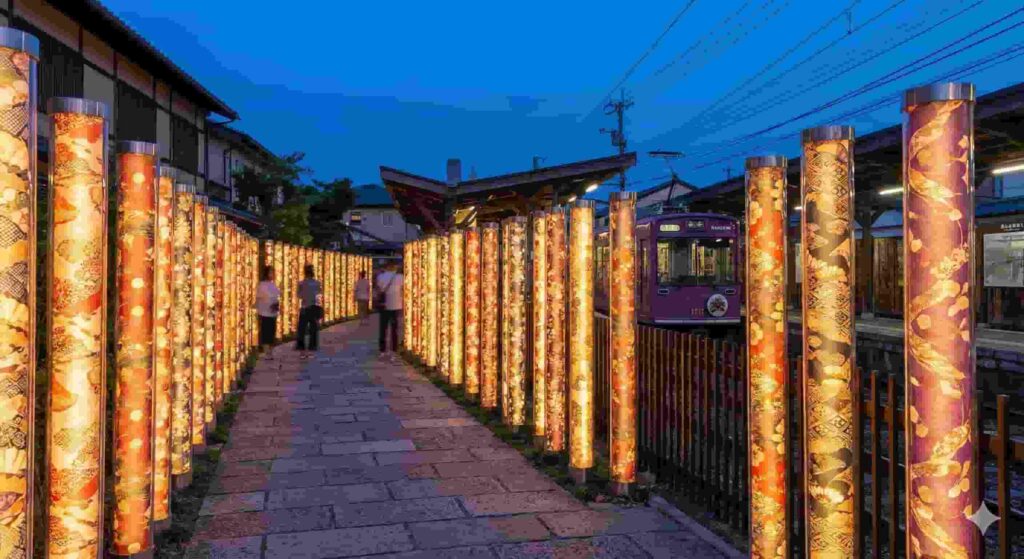
Traveler’s Note: The Kimono Forest is illuminated at night (usually until 9:00 PM). If you finish your tour late, circle back here for an ethereal, domain-expansion-like atmosphere.
2. Into the Green: The Bamboo Grove (Chikuirin)
This is the main event. The location every Jujutsu Kaisen fan must visit.
The “Vivid Vice” Location
In the second opening sequence, there is a distinct shot of the characters walking through a towering, narrow path of bamboo. This is the Arashiyama Bamboo Grove.
How to Get There from the Station
- Exit JR Saga-Arashiyama Station via the South Exit.
- Walk west through the residential streets (follow the signs for “Bamboo Grove”).
- The walk takes approximately 10-15 minutes.
- You will enter the grove from the side near the Nonomiya Shrine.
The Atmosphere
The bamboo stalks here soar over 30 meters high, blocking out the sky and creating a strange, green twilight even at midday. The sound of the wind rustling the stalks (one of the “100 Soundscapes of Japan”) creates a sensory deprivation effect that feels remarkably like a Domain Expansion.
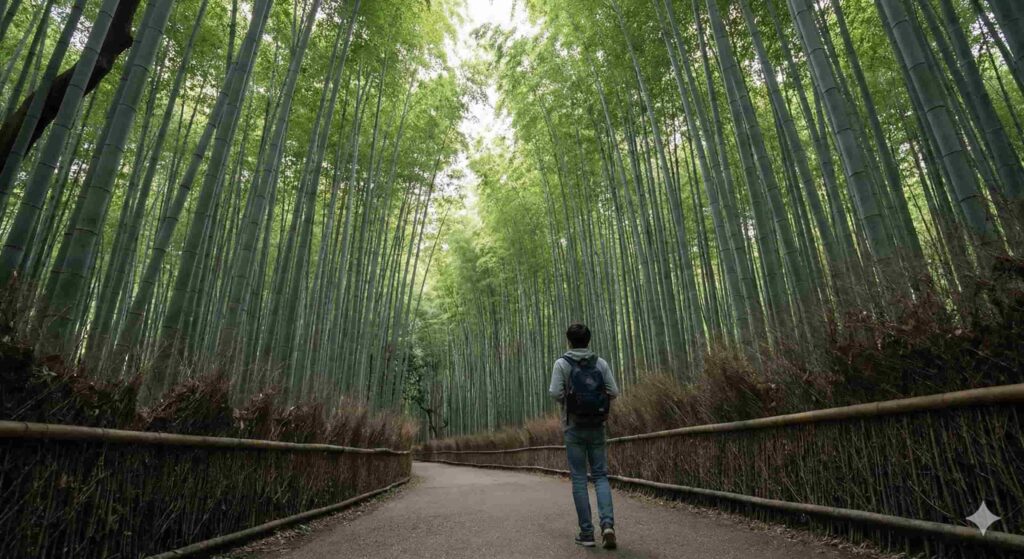
Key Spot to Locate:
Walk towards the middle of the path where the slope begins to rise slightly. This creates the “tunnel” effect seen in the anime opening.
- Photography Tip: To replicate the anime shot, you need a low angle. Crouching down and shooting upwards emphasizes the height of the bamboo, making the subject (you or your cosplay partner) look like they are enveloped by the forest. Use a wide-angle lens (16mm-24mm) if possible.
The Crowd Problem (and Solution)
Arashiyama is one of the busiest tourist spots in Japan.
- The “Sorcerer’s Hour”: To get the empty, eerie shot seen in Jujutsu Kaisen, you must arrive early. We recommend arriving at 6:30 AM or 7:00 AM. By 9:00 AM, the path is flooded with tourists, breaking the immersion.
- Alternate Route: If the main path is too crowded, head towards the back of Tenryu-ji Temple. There are connecting paths that offer similar bamboo visuals with fewer people.
3. Nonomiya Shrine: The Spiritual Anchor
Located right inside the Bamboo Grove is Nonomiya Shrine.
Connection to Cursed Energy
While not explicitly named in the anime, Nonomiya Shrine is historically significant. It was a sanctuary for imperial princesses to purify themselves before serving at the Ise Grand Shrine.
- Lore Integration: In the context of Jujutsu Kaisen, places of high purity or high trauma generate Cursed Energy. A shrine devoted to purification is exactly where a Jujutsu Sorcerer would stop to investigate residual energy.
- The Black Torii: The shrine features a rare black Torii gate. It looks strikingly modern and vaguely ominous—perfect for JJK aesthetics.
Action Item: Purchase an Omamori (charm) here. They have specific charms for “travel safety”—essential for anyone navigating the Culling Game or just the JR rain system.
4. Togetsukyo Bridge: The Crossing
After exiting the Bamboo Grove and passing through Tenryu-ji (a World Heritage site worth seeing), head south toward the river to find Togetsukyo Bridge (Moon Crossing Bridge).
The Scenic Backdrop
This wooden bridge spans the Katsura River with Arashiyama Mountain in the background. It appears in countless establishing shots of Kyoto in anime.
- The Vibe: This is where the Tokyo and Kyoto students would likely cross to enter the city proper. The wide open space contrasts with the claustrophobia of the Bamboo Grove.
- Seasonal Changes:
- Autumn: The mountain explodes in red and orange (reminiscent of Nobara’s Hammer resonance).
- Spring: Cherry blossoms frame the river (reminiscent of the fleeting nature of youth in the series).
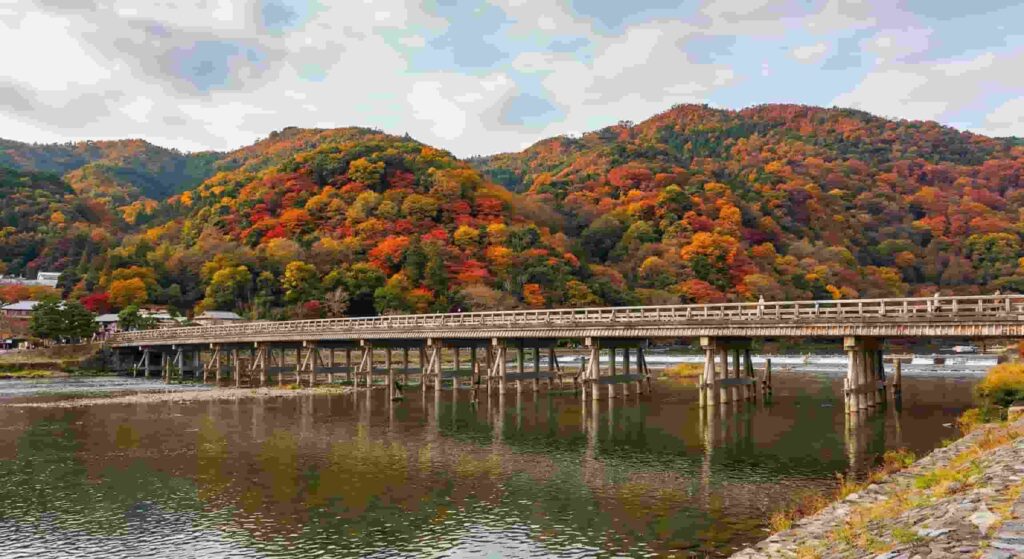
A Moment of Reflection
Stand on the bridge and look upstream. The Hozu River boat ride terminates here. It is a peaceful spot to reflect on the tragedy of the Shibuya Incident or simply enjoy the breeze.
5. JJK Photography Guide: nailing the Aesthetic
To make your photos look like they belong in the anime, you need to mimic the cinematography of MAPPA.
| Location | Lens/Focal Length | Angle | Editing Style |
| Bamboo Grove | Wide (16-24mm) | Low, looking up | High contrast, saturate the greens, slightly cool temperature. |
| Kimono Forest | Portrait (50mm-85mm) | Eye level, depth of field | Vibrant colors, boost neon purples and reds. |
| Togetsukyo Bridge | Telephoto (85mm+) | From the riverbank | Soft, cinematic, natural lighting. |
| Station Area | Standard (35mm) | Candid / Street style | Gritty, urban, desaturated. |
Style Tip: If you are cosplaying, Arashiyama is generally cosplay-friendly if you are respectful. Do not block paths. However, for full gear (weapons/wigs), it is often better to book a private studio or check for specific cosplay events in Kyoto. For casual street clothes “inspired” by characters (like Gojo’s casual fit or Nobara’s shopping outfit), you will fit right in.
6. Where to Eat: Sorcerer Sustenance
Even Satoru Gojo needs his sweets. Here are the spots in Arashiyama to fuel up.
- % Arabica Kyoto Arashiyama:
- Located right on the riverbank. The minimalist white design screams “Gojo Satoru aesthetic.” The line is long, but the coffee is top-tier.
- Yojiya Cafe:
- Famous for their matcha cappuccinos with the face art. Very Kyoto.
- Local Street Food:
- Near the station, look for Yuba Cheese (fried fish cake with tofu skin and cheese). It’s a savory snack that Itadori would definitely buy three of.
7. Itinerary: The “Kyoto Exchange” Route
To maximize your time and hit all the spots efficiently, follow this chronological plan.
- 07:00 AM: Arrive at JR Saga-Arashiyama Station.
- 07:20 AM: Enter the Bamboo Grove. Take photos while it is empty.
- 08:00 AM: Visit Nonomiya Shrine within the grove.
- 08:30 AM: Enter Tenryu-ji Temple (gardens open at 8:30). Walk through the garden to exit onto the main street.
- 09:30 AM: Walk to Togetsukyo Bridge. Take photos from the riverbank.
- 10:30 AM: Coffee break at % Arabica.
- 11:30 AM: Walk back towards the center to Randen Arashiyama Station. See the Kimono Forest.
- 12:30 PM: Lunch in the station area.
- 01:30 PM: Depart for Fushimi Inari (another major JJK location) or back to Kyoto Station.
Frequently Asked Questions (FAQ)
Q: Is the Kyoto Jujutsu High School a real place?
A: No, the school itself is located deep in the mountains and is fictional. However, its architecture is inspired by traditional temples found throughout Kyoto, heavily resembling complexes like Enryaku-ji on Mount Hiei.
Q: How much does it cost to visit the Bamboo Grove?
A: The Arashiyama Bamboo Grove is free to enter and open 24/7. However, Tenryu-ji Temple requires an entrance fee (approx. 500 yen).
Q: Can I wear anime cosplay in Arashiyama?
A: Japan has strict etiquette regarding cosplay. Walking around in full costume (wigs, makeup, props) in public areas is generally frowned upon unless it is a designated event. We recommend “bounding” (dressing in normal clothes that color-match the characters) for the best experience without drawing negative attention.
Q: What is the best season to visit?
A: Late November (Autumn foliage) matches the darker, ancient aesthetic of Jujutsu Kaisen perfectly. However, the bamboo grove is green year-round.
Conclusion: Expanding Your Domain
Visiting Arashiyama is more than just checking boxes on a map. It is about immersing yourself in the texture of the world that Gege Akutami created. The rustle of the bamboo, the flow of the river, and the ancient shrines all contribute to the feeling that Cursed Energy might just be real.
Whether you are Team Tokyo or Team Kyoto, this walking tour brings you closer to the series you love. The barrier between fiction and reality is thin here—step through it.
See you in Kyoto, Sorcerers.
Disclaimer: Please respect all local rules and regulations while visiting these heritage sites. Do not damage the bamboo or block traffic for photos.