














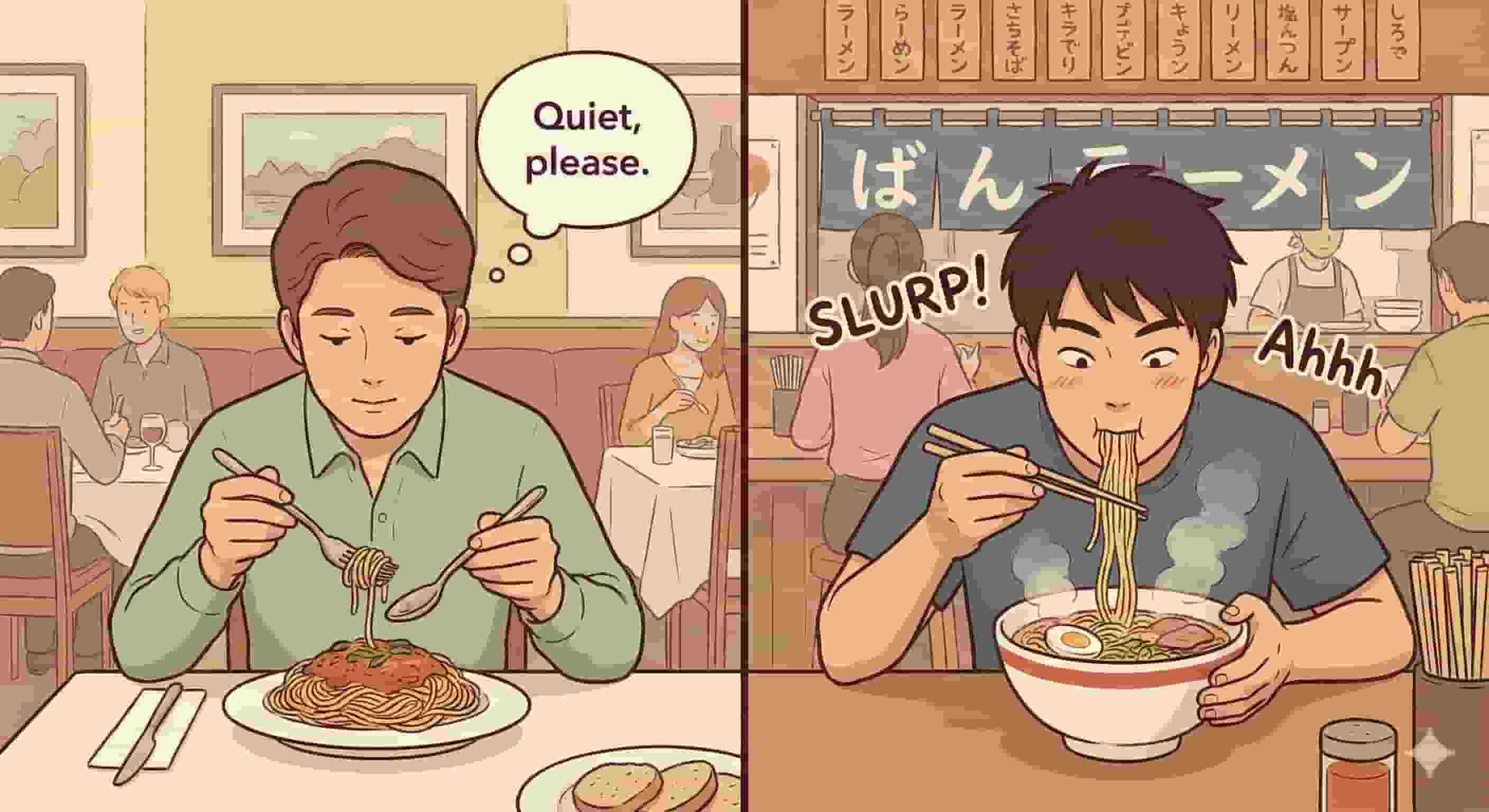
Imagine sitting at a counter in Tokyo. The steam rises from a rich, porcelain bowl of Tonkotsu ramen. You pick up your chopsticks, ready to eat, but the air is filled with a chorus of loud, rhythmic suction sounds. To a Western ear, it sounds like bad manners. To a local, it sounds like lunch.
This “slurp shock” is one of the first hurdles travelers face in East Asia. In the West, silence is the gold standard of dining etiquette. In Japan, however, silence over a bowl of soba is a sign that you might be missing the point entirely.
But is slurping always okay? Does it apply to every noodle dish? And more importantly, does it actually make the food taste better?
This comprehensive guide goes beyond the basics. We are diving deep into the science of retronasal olfaction, the cultural concept of nodogoshi, and the specific “slurp zones” where the rules change completely.
- The Cultural Divide: Why We Slurp
- The “Local” Truth: When is it Okay? (And When is it NOT?)
- How to Slurp Like a Pro: A Step-by-Step Guide
- Beyond Japan: Noodle Etiquette in Asia
- The “Sound of Appreciation” Myth
- Essential Accessories for the Noodle Lover
- FAQ: Common Noodle Anxieties
- Conclusion: Embrace the Noise
The Cultural Divide: Why We Slurp
Understanding the “Why” Before the “How”
To understand why Japanese people (and many other Asian cultures) slurp, we have to dismantle the Western notion of dining noise. In Victorian-influenced table manners, noise indicates a lack of control. In Japanese noodle culture, the slurp—or susuru—is a functional tool, not a lapse in judgment.
1. The Temperature Factor
Ramen, Udon, and Soba are often served at volcanic temperatures—near boiling. If you wait for the noodles to cool naturally in the bowl, they will overcook and become soggy (a state known as nobiru).
- The Slurp Solution: The act of slurping intakes cool air alongside the hot noodles. This rapid airflow cools the noodles instantly as they enter your mouth, allowing you to eat them while they are at their peak texture (chewy and firm) without burning your tongue.
2. The Science of Flavor (Retronasal Olfaction)
This is where the elite foodies pay attention. Slurping is effectively the same technique wine sommeliers use when they “gargle” wine in their mouth.
- Aeration: By sucking air into the mouth along with the broth and noodles, you vaporize the volatile aromas of the soup.
- The Nasal Connection: These vapors travel from the back of the mouth up to the nose (retronasal olfaction). Since a huge percentage of “taste” is actually “smell,” slurping creates a more explosive, high-definition flavor profile than chewing quietly ever could.
3. Nodogoshi: The Joy of the Throat
In Japan, there is a specific culinary term called nodogoshi ($喉越し$). It refers to the pleasurable sensation of food sliding down the throat. Soba noodles, in particular, are prized for their slippery texture. If you chew them too much, you ruin the nodogoshi. Slurping propels the noodles past the tongue and down the throat, maximizing this tactile sensation.
The “Local” Truth: When is it Okay? (And When is it NOT?)
Nuance is Key: Not All Noodles Are Created Equal
This is the most critical section for travelers. A common mistake is assuming that all noodles should be slurped in Asia. This is false and can lead to awkward stares.
The “Green Light” Zone: Slurp Away
- Ramen: Absolutely essential. The soup is fatty and complex; slurping marries the soup to the noodle.
- Soba (Buckwheat Noodles): The holy grail of slurping. Traditionalists say you should barely chew soba.
- Udon: Yes, though because the noodles are thicker, the sound is often deeper and heavier.
- Somen: Thin wheat noodles usually eaten cold. Slurping is standard.
The “Red Light” Zone: Do Not Slurp
- Pasta (Spaghetti/Fettuccine): Even in Japan, Italian food is eaten with Western etiquette. Slurping your carbonara in Tokyo will get you strange looks. It is considered uncouth.
- Cut Noodles (Short pieces): If the noodles are cut into bite-sized pieces (like macaroni), slurping is impossible and unnecessary.
- Rice: Never slurp solid rice. It implies you are eating like an animal. (Tea-over-rice, or Ochazuke, is a slight exception, but keep it quiet).
Pro Tip: If you are eating at a fusion restaurant or a high-end Kaiseki dining establishment, observe the locals first. When in doubt, mirror the person with the most gray hair in the room.
How to Slurp Like a Pro: A Step-by-Step Guide
Mastering the Technique Without the Splatter
Many Westerners try to slurp and end up choking or splashing broth on their shirts. This happens because they try to inhale with their lungs rather than using the vacuum of the mouth.
The Mechanics of the Perfect Slurp:
- The Lift: Pick up a manageable amount of noodles (about 3-5 strands). Do not grab a massive clump; it will be too heavy to lift via suction.
- The Dip: Lift the noodles out of the soup, then dip them back in once to coat them in fat and broth.
- The Purse: Shape your lips like you are about to whistle or sip through a straw. This is crucial—you need a narrow aperture to create speed.
- The Vacuum: Bring the noodles to your lips. Inhale sharply and quickly through your mouth, sucking the noodles in. Crucial: Do not inhale into your lungs! Use your mouth cavity like a vacuum pump.
- The Cut: Once the noodles are in your mouth, bite off the ends if they are too long (though traditionalists try to take the whole length).
Table: Troubleshooting Your Slurp
| Problem | Cause | Solution |
| Broth Splatter | Opening mouth too wide or slurping too slowly. | Purse lips tighter. Speed creates a clean stream; slowness creates wobble and splash. |
| Choking | Inhaling into the lungs. | Focus on “sipping” air into the mouth only, not a deep breath. |
| No Sound | Not enough air intake. | You are being too polite. Suck harder! The sound is a byproduct of speed. |
Beyond Japan: Noodle Etiquette in Asia
Don’t assume Japanese rules apply everywhere
While Japan is the capital of the slurp, the rules vary significantly across the continent.
China:
Slurping is generally acceptable and often indicates enjoyment, especially with hot soups. However, in formal banquets or modern high-end dining, silent eating is becoming more common among the younger generation.
- Verdict: Safe to slurp in casual spots; read the room in fine dining.
South Korea:
The rules here are stricter. While some noise is inevitable with hot spicy soups (like Jjamppong), loud, deliberate slurping can be seen as uncouth by older generations. Furthermore, lifting the bowl to your mouth (a common move in Japan) is considered rude in Korea. You must leave the bowl on the table and use a spoon.
- Verdict: Moderate your volume. Use the spoon for broth.
Vietnam (Pho):
Vietnamese etiquette is a blend. You use chopsticks in one hand and a spoon in the other. You place noodles into the spoon with some broth and eat from the spoon, or lift noodles from the bowl. Light slurping is fine, but the aggressive “vacuum” sound of a Tokyo ramen shop is less common here.
- Verdict: Gentle slurping is fine; aggressive noise is unnecessary.
The “Sound of Appreciation” Myth
Debunking a common travel guide trope
You will often read in outdated travel guides: “You MUST slurp loudly to show the chef you like the food!”
This is largely a myth.
While the chef certainly won’t be offended by the sound, Japanese people do not slurp for the chef. They slurp for themselves—for the flavor and the cooling effect. If you eat silently, the chef won’t think you hate the food; they will just assume you are a foreigner or have sensitive teeth.
Do not force a fake slurp. It sounds theatrical and sarcastic. If you can’t do it naturally, it is better to eat quietly and compliment the chef verbally (“Oishii desu!”) than to spray broth everywhere in a performance of “appreciation.”
Essential Accessories for the Noodle Lover
Protecting your clothes while you learn
If you are committed to mastering the slurp, you need to accept that splash damage is a real threat.
- The Paper Apron: Most ramen shops in Japan offer a paper bib (ask for a “kamie-puron”). Do not be too proud to wear it. Even business executives in $5000 suits wear the bib.
- Dark Clothing: If you are planning a ramen tour, leave the white t-shirt at the hotel.
- The “Face Dip”: To minimize splashing, lower your head closer to the bowl. The shorter the distance the noodles travel, the less they wiggle and spray.
FAQ: Common Noodle Anxieties
Q: Is it rude to drink the broth from the bowl?
A: In a ramen shop? No. It is a compliment. However, the broth is high in sodium, so don’t feel pressured to finish it all. In formal dining, use the spoon (renge).
Q: Can I bite the noodles in half?
A: Ideally, no. In Japanese culture, long noodles symbolize longevity. Cutting them is technically bad luck (and bad manners). However, nobody will yell at you if you do it discreetly.
Q: What if I’m left-handed?
A: Seating at ramen counters is tight (elbow-to-elbow). If you are left-handed, try to sit on the far left end of the counter to avoid bumping elbows with your neighbor.
Conclusion: Embrace the Noise
So, is slurping noodles actually okay? Yes. In the context of a hot bowl of ramen or soba in Japan, it is not just okay—it is the optimal way to experience the dish. It unlocks flavor profiles hidden to the silent eater and ensures you enjoy the meal at its perfect temperature.
However, context is your compass. Do not slurp your spaghetti in Rome, and don’t slurp your soup in a Michelin-star French restaurant.
Food is the ultimate gateway to culture. By learning to slurp, you aren’t just learning a table manner; you are learning to breathe, taste, and enjoy food exactly as the locals do. So take a deep breath, purse your lips, and slurp with confidence.
Next Step
Ready to put your skills to the test? discover the top 10 hidden gems where you can practice your slurping technique like a true local.
Next…
- [Top 10 Hidden Ramen Shops in Tokyo: The Ultimate Guide to Secret Bowls & Local Legends]
- [Stop Tipping! Why it’s Actually Rude in Japan (And What to Do Instead)]
- [Soba vs. Udon: What’s the Difference?]