








- The “No Tipping” Shock
- The Philosophy of Perfection: Understanding Omotenashi
- Why Tipping is Considered Rude (The Psychological Breakdown)
- The Hidden Costs: You Are Already Paying for Service
- Comprehensive Tipping Scenarios: A Tourist’s Guide
- The Nuance: When is Tipping Actually Acceptable?
- How to “Tip” Without Being Rude: The Envelope Rule
- What to Do Instead: The Currency of Gratitude
- Conclusion: Respecting the Culture is the Best Tip
The “No Tipping” Shock
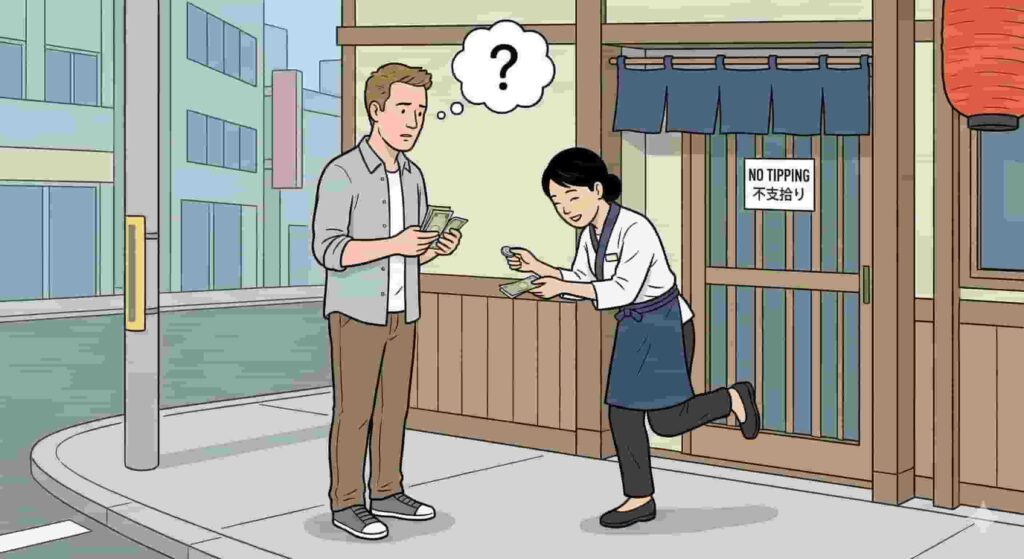
Imagine this: You have just finished a spectacular multi-course meal in Tokyo. The sushi was fresh, the sake was divine, and the chef treated you like royalty. Your bill comes to 15,000 yen. Grateful for the experience, you leave 17,000 yen on the tray, intending the extra 2,000 yen as a thank you. You bow, walk out, and start heading down the street.
Suddenly, you hear running footsteps behind you. It’s your server. They are out of breath, waving the 2,000 yen bill you “forgot.” They hand it back to you with a concerned smile, bowing apologetically for stopping you. You stand there, confused and slightly embarrassed.
Welcome to Japan.
For travelers from the United States, Canada, or Europe, the concept of not tipping is alien. We are trained to believe that tipping is the only way to show respect for good service. But in Japan, the script is flipped. Tipping isn’t just unnecessary; it can be actively rude, confusing, and culturally insensitive.
This comprehensive guide will not only explain why you should keep your change but also dive deep into the beautiful philosophy of Omotenashi that makes Japan’s service industry the best in the world. By the end of this article, you will know exactly how to navigate payment etiquette like a local, ensuring you leave smiles—not confusion—in your wake.
Related Posts
[The ‘Otoshi’ Trap: Why You Got an Appetizer You Didn’t Order at Izakaya]
The Philosophy of Perfection: Understanding Omotenashi
To understand why tipping is rejected, you must first understand the cultural bedrock of Japanese service: Omotenashi (おもてなし).
What is Omotenashi?
Often translated simply as “hospitality,” Omotenashi is far more nuanced. It is a compound concept rooted in the traditional tea ceremony (sado). It implies a level of service that anticipates the guest’s needs before they are even aware of them.
- Omote (Front/Face) + Nashi (None): One interpretation is “no front,” meaning no hidden side or ulterior motive. The service is given with a pure heart, not in expectation of a reward (like a tip).
- Anticipation: A good waiter refills your water when it’s half empty, not when you ask. A great hotel concierge offers you an umbrella before you notice it’s raining.
In Western cultures, service is often transactional: “I do this for you; you pay me extra.” In Japan, exceptional service is the baseline standard. It is taken for granted that a professional will perform their job to the best of their ability. To offer a tip is to suggest that their employer does not pay them enough, or worse, that they only provided good service because they wanted your money.
The Dignity of Labor
Japan places immense value on shokunin kishitsu (the craftsman’s spirit). Whether someone is a sushi master, a taxi driver, or a convenience store clerk, they take pride in their role.
When you tip, you are introducing a power dynamic that doesn’t exist in their mind. You are essentially saying, “Here is a handout for doing a good job.” To a proud worker, this can feel patronizing. They are professionals; their salary is the compensation for their work, and your satisfaction is the validation of their skill.
Why Tipping is Considered Rude (The Psychological Breakdown)
It is difficult for Westerners to internalize that giving money could be offensive. Here is a breakdown of the Japanese perspective to help you adjust your mindset.
1. The Confusion Factor
Japan is a society of rules and systems. When you go “off-script” by leaving money on a table, you create chaos.
- The Register Mismatch: Japanese cash registers are balanced to the exact yen. If there is extra money, it creates an accounting error. The staff now has to decide: Is this lost property? Is it a mistake? How do we report this?
- The “Chase” Phenomenon: As mentioned in the intro, staff will often assume you made a math error and forgot your change. By leaving a tip, you are forcing them to run after you, causing them inconvenience—the exact opposite of what you intended.
2. The Suggestion of Inferiority
In the Edo period, gifts of money were often given by superiors to subordinates (like a lord to a servant). By tipping, you unconsciously position yourself as the “lord” and the server as the “servant” in need of charity. In a culture that values equality in the customer-provider relationship (where the customer is god, but the provider is the priest), this disrupts the harmony.
3. The Corruption of Service
There is a fear that introducing tipping culture would ruin Omotenashi. If staff start working for tips, they might prioritize wealthy-looking customers over others. The Japanese system ensures that a billionaire and a student receive the exact same level of bow and attention at a restaurant.
The Hidden Costs: You Are Already Paying for Service
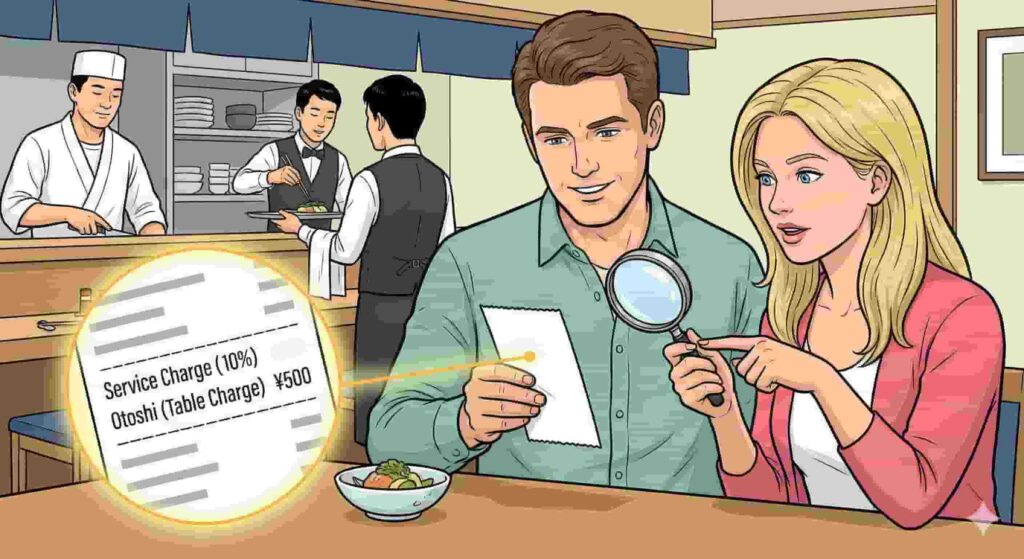
One reason you don’t need to tip is that the service cost is often built into the bill structurally. You aren’t “skipping” the tip; you are paying it via a different mechanism.
The “Service Charge” (Saabisu Ryou)
At high-end establishments—luxury hotels, ryokans (traditional inns), and upscale restaurants—check your bill carefully. You will likely see a line item for Service Charge (サービス料).
- Standard Rate: Usually 10% to 15%.
- Transparency: This is mandatory and automatic. It ensures that the establishment can pay their staff a living wage without relying on the whims of customers.
The “Otoshi” (Table Charge)
If you enter an Izakaya (Japanese gastropub) or a bar, you will almost certainly be served a small appetizer the moment you sit down. This is called Otoshi (お通し) or Tsukidashi.
- The Cost: usually 300 to 500 yen per person.
- The Purpose: This acts as a seating charge. It covers the cost of your seat and the staff’s attention.
- Etiquette: Do not refuse the Otoshi, even if you don’t eat it. It is the cultural equivalent of a cover charge or a mandatory tip. Refusing it is considered gauche and signals that you don’t understand the system.
Comprehensive Tipping Scenarios: A Tourist’s Guide
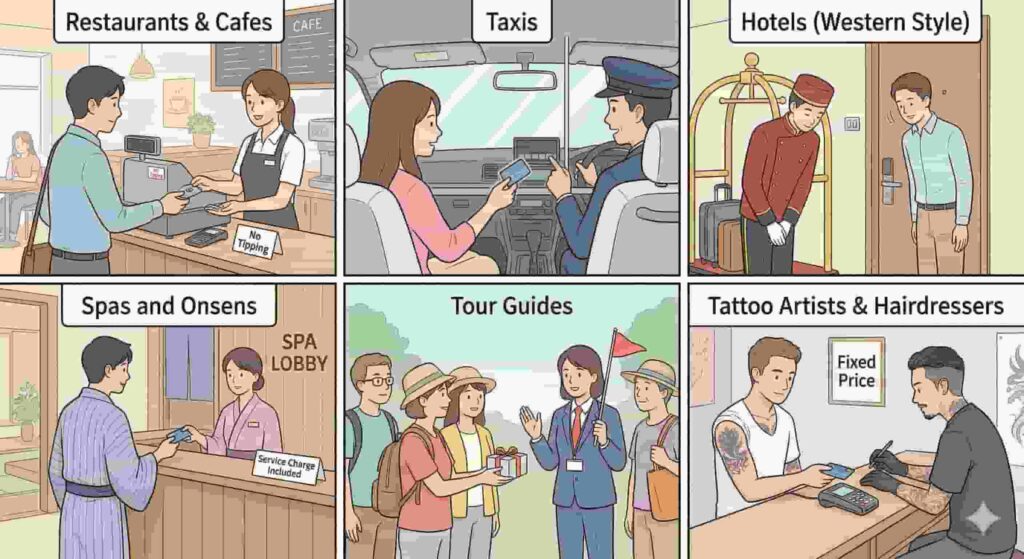
To ensure you never face an awkward moment, let’s look at every specific scenario you might encounter on your trip.
1. Restaurants and Cafes
- Rule: Absolutely No Tipping.
- Scenario: You buy a coffee for 450 yen. You hand over a 500 yen coin.
- Action: Wait for your 50 yen change. Put it in your wallet. If there is a “charity box” (often for Guide Dogs or Earthquake Relief) by the register, you can put the change there, but never leave it for the staff.
- At the Table: Do not leave cash on the table. Most payments are done at the register near the exit, not at the table.
2. Taxis
- Rule: No Tipping.
- Scenario: The ride costs 1,480 yen. You hand the driver 2,000 yen.
- Action: The driver will automatically hand you 520 yen.
- Exception: If you tell the driver “Keep the change” (Otsuri wa irimasen), they may accept it to save the hassle of counting small coins, but it is not expected. It is better to just accept the change.
3. Hotels (Western Style)
- Rule: No Tipping.
- Scenario: The bellhop carries your bags to your room.
- Action: A sincere “Thank you” is sufficient. They will bow and leave. Do not try to press a 1,000 yen note into their hand; they may recoil or look panicked. Housekeeping also does not expect tips left on the pillow.
4. Spas and Onsens
- Rule: No Tipping.
- Context: Massage therapists and onsen staff are medical or service professionals. Tipping them is seen as unusual as tipping your dentist.
5. Tour Guides
- Rule: Optional / Gray Area.
- Context: This is the one area where Western influence has crept in.
- Free Tours: If you are on a “Free Walking Tour,” the guides usually rely on tips. In this specific case, tipping is expected.
- Private Guides: If you hired a private guide for a full day, they do not expect a tip, but they are often accustomed to foreigners offering one. It is acceptable here, but handle it correctly (see “How to Tip” below).
- Bus Tours: No tip required for the driver or guide.
6. Tattoo Artists & Hairdressers
- Rule: No Tipping.
- Context: You are paying for their art and skill. The price on the menu is the price.
The Nuance: When is Tipping Actually Acceptable?
There are rare, high-context situations where giving money is traditional. This is not “tipping” in the Western sense, but rather Kokorozuke (心付け)—a gesture from the heart.
The Ryokan Exception
If you are staying at a high-end, traditional Ryokan (Japanese inn) where dinner is served in your room by a dedicated attendant (Nakai-san), the rules shift slightly.
- Timing is Key: Unlike Western tips given after service, Kokorozuke is given at the beginning of the stay, usually when the attendant first shows you to your room and serves you tea.
- The Meaning: It says, “Please take care of us during our stay.”
- Amount: usually 1,000 to 3,000 yen is appropriate.
Weddings and Funerals
If you are invited to a Japanese wedding or funeral, you must give money.
- Weddings: Goshugi (celebratory money). Usually 30,000 yen minimum for friends.
- Funerals: Koden (condolence money).
- Crucial Rule: These must be new, crisp bills for weddings, and older, worn bills for funerals (symbolizing that you didn’t prepare for the death).
How to “Tip” Without Being Rude: The Envelope Rule
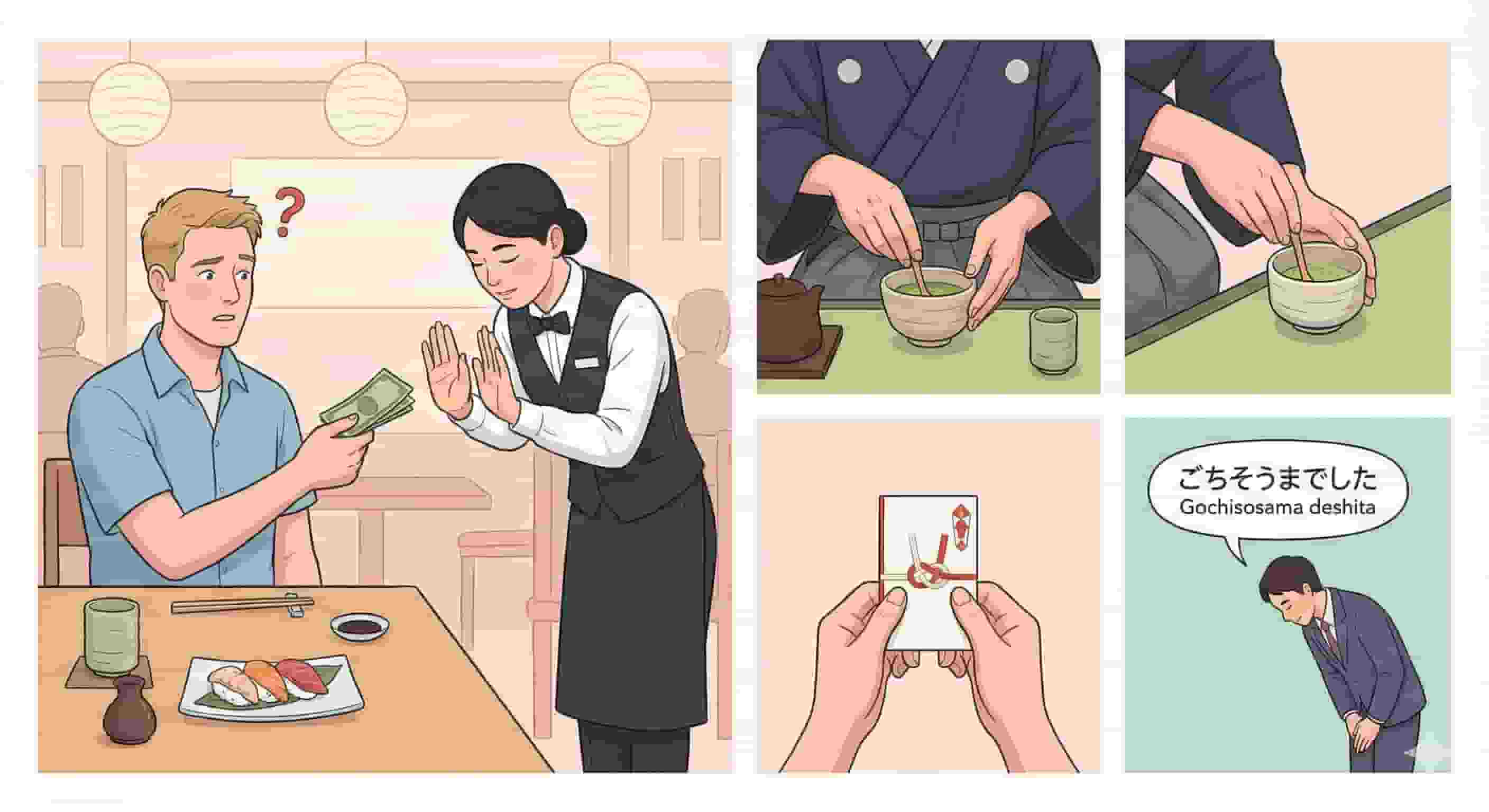
If you fall into one of the rare exceptions (private guide, Ryokan attendant) and decide to give money, you must not pull naked cash out of your pocket. This is considered dirty and crass.
The Golden Rules of Kokorozuke:
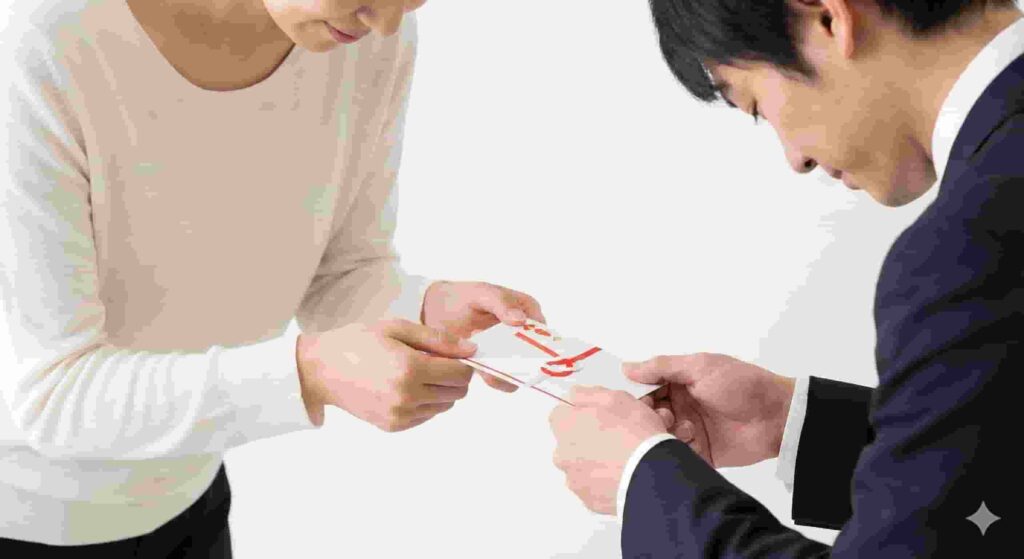
Use an Envelope: You must place the money inside a small envelope called a Pochi-bukuro or simply wrap it in clean white paper. Never hand over bare bills.
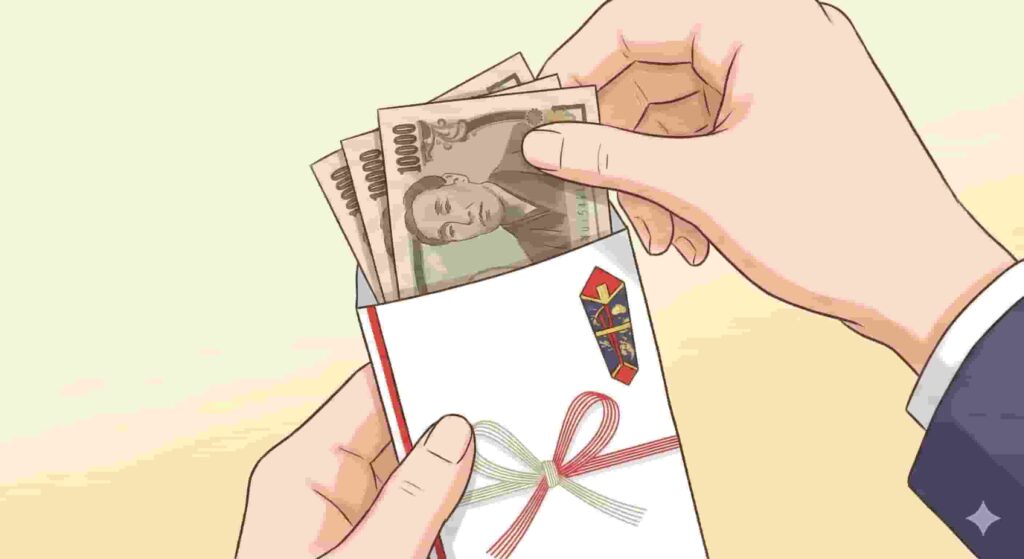
New Bills: Try to use clean, unwrinkled bills if possible.
Two Hands: Present the envelope with both hands, bowing slightly.
The Phrase: Say “Hon no kimochi desu” (It’s just a small token of my feelings) or “Osewa ni narimasu” (Thank you for taking care of me).
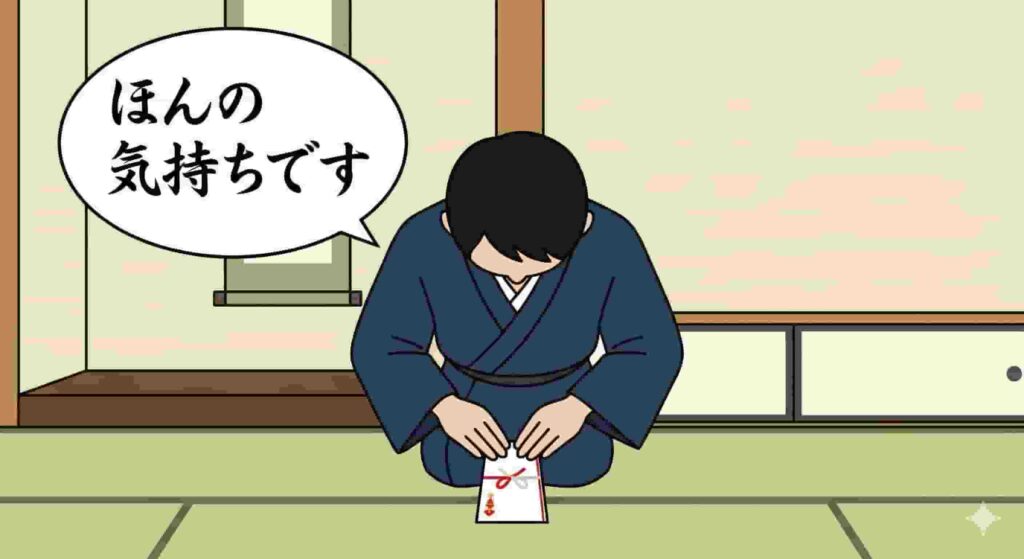
If you try to tip without an envelope, you will likely be refused. The envelope acts as a barrier that dignifies the exchange, turning “money” into a “gift.”
What to Do Instead: The Currency of Gratitude
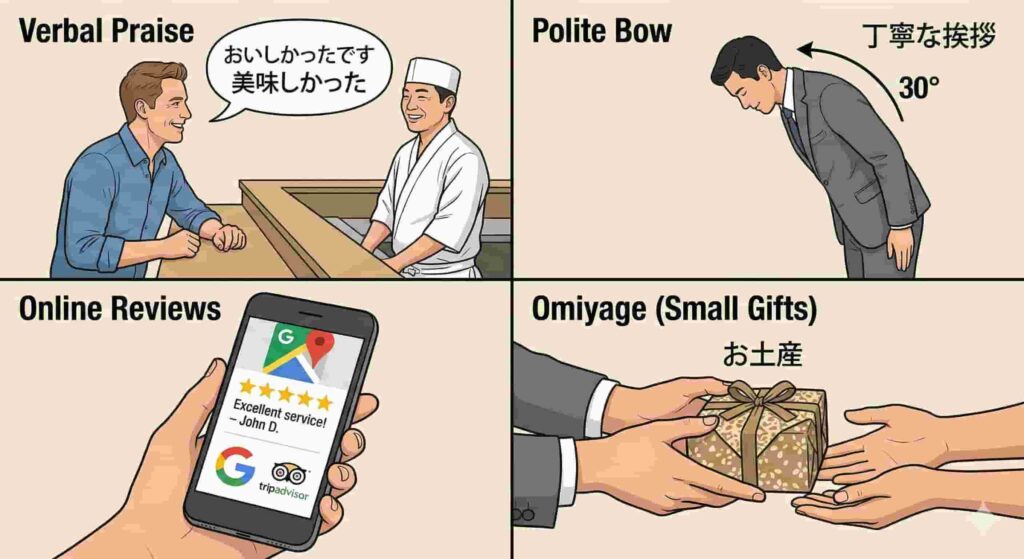
So, if you can’t use money, how do you show a Japanese person that you truly appreciated their work? In Japan, social currency is worth more than cash.
1. Verbal Praise (The Power of Phrases)
Japanese service staff value recognition. Use these phrases to make their day:
- Arigato Gozaimasu: (Thank you very much). Say this with eye contact and a nod.
- Gochisosama Deshita: (Thank you for the feast). Crucial. Say this to the chef or staff as you leave a restaurant. It signals that you enjoyed the food and acknowledges their labor.
- Oishikatta Desu: (It was delicious).
2. The “Polite Bow”
You don’t need to do a full 90-degree bow. A small, respectful nod of the head (about 15 degrees) when receiving your change or your food shows that you see them as an equal.
3. Google/TripAdvisor Reviews
This is the modern tip. Japanese businesses are obsessed with reputation.
- Action: Leave a detailed review mentioning the staff member’s name if possible. “Service by Hanako-san was exceptional.”
- Why it works: This can lead to promotions or bonuses for the staff member internally, which is far more valuable than a 500 yen coin.
4. Omiyage (Small Gifts)
If you are visiting a friend or have a guide for a week, money is cold. A small gift (Omiyage) from your home country is warm.
- Ideas: Local sweets, a keychain, or a small postcard from your hometown.
- Context: Do not do this for a waiter you met for 45 minutes. This is for people you have built a rapport with over hours or days.
Conclusion: Respecting the Culture is the Best Tip
Traveling to Japan is an exercise in mindfulness. The “No Tipping” rule isn’t about saving money—it’s about stepping into a different value system. A system where pride, dignity, and equality take precedence over transactional bonuses.
By keeping your wallet closed and your heart open, you are showing the ultimate respect to the Japanese people. You are telling them, “I see your hard work, I respect your professionalism, and I accept your hospitality as the gift it is intended to be.”
So, the next time you receive flawless service in Tokyo, Kyoto, or Osaka, fight the urge to reach for your cash. Instead, smile, bow slightly, and say a heartfelt “Gochisosama deshita.” That memory will last them longer than any bill ever could.