













Best Cherry Blossom Spots in Japan: A Journey Through Pink Petals and History
Spring in Japan is not merely a season; it is a cultural phenomenon that transforms the entire archipelago into a breathtaking canvas of soft pinks and whites. As the winter chill recedes, the anticipation for Hanami—the centuries-old tradition of flower viewing—reaches a fever pitch among locals and travelers alike. However, with thousands of scenic locations scattered across the country, distinguishing a crowded tourist trap from a life-changing experience can be a daunting task for visitors.
For travelers seeking the ultimate spring itinerary, identifying the best cherry blossom spots in Japan is the crucial first step toward witnessing one of nature’s most spectacular events. Whether you are seeking the dramatic backdrop of a feudal castle, the spiritual serenity of an ancient temple, or a vibrant city park filled with revelers, this comprehensive guide curates the top 25 essential destinations. From the northern wilds of Hokkaido to the subtropical ruins of Okinawa, we have analyzed historical significance, visual impact, and bloom timing to help you build the perfect journey.
- Why These Are the Best Cherry Blossom Spots in Japan
- Hokkaido: The Grand Finale of Spring
- Tohoku Region: The Deep North’s Dramatic Blooms
- Kanto Region: Tokyo and Surrounds
- Chubu & Hokuriku: Mountains and Castles
- Kansai Region: The Historical Heart
- Chugoku, Shikoku & Kyushu: West Japan’s Gems
- Okinawa: The First Breath of Spring
- Conclusion: Crafting Your Perfect Sakura Itinerary
Why These Are the Best Cherry Blossom Spots in Japan
Before diving into the list, it is crucial to understand that the “Sakura Front” sweeps across Japan from South to North. While Tokyo peaks in late March, Hokkaido is best visited in May. This guide is structured to help you chase the bloom no matter when you arrive. We have analyzed these locations based on historical significance, visual impact (scale and variety), and unique accessibility.
Planning the rest of your trip? This article is just one part of the season. To get the full picture—including the 2026 Cherry Blossom Forecast, Golden Week survival tips, and Skiing advice—check out my main guide:
👉 Read the Ultimate Guide to Spring in Japan 2026
Hokkaido: The Grand Finale of Spring
When the rest of Japan settles into early summer, Hokkaido offers a second chance to witness the best cherry blossom spots in Japan.
1. Matsumae Park (Hokkaido)
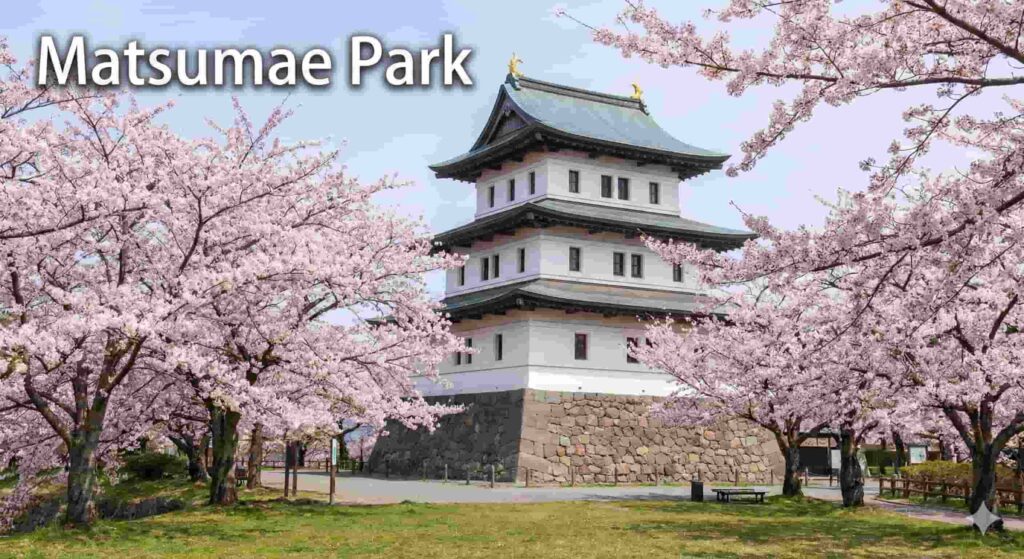
The Living Museum of Sakura
- Address: Matsushiro, Matsumae-cho, Matsumae-gun, Hokkaido
- Access: Approx. 2.5 hours by car from Hakodate Airport (3 hours by bus from Hakodate Station).
- Map: Google Maps Link
- Best Time to Visit: Late April to Late May
- Key Features: 250 varieties, 10,000 trees, Long blooming season.
Matsumae Park is a sanctuary for sakura enthusiasts and is the only castle town in Hokkaido. Its defining characteristic is the staggering variety of cherry trees—over 250 types and 10,000 individual trees inhabit this space. Unlike other spots that bloom and fade in a week, Matsumae offers a “Sakura Relay,” where early bloomers pass the baton to late bloomers, allowing for a month-long viewing window.
The juxtaposition of Matsumae Castle (Fukuyama Castle) against the floral backdrop is iconic. Be sure to look for the “Naden” and “Matsumae Hayazaki” varieties, which were born here. The park also houses a “Sakura Sample Garden,” serving as a living museum for preservation and research.
2. Goryokaku Park (Hokkaido)
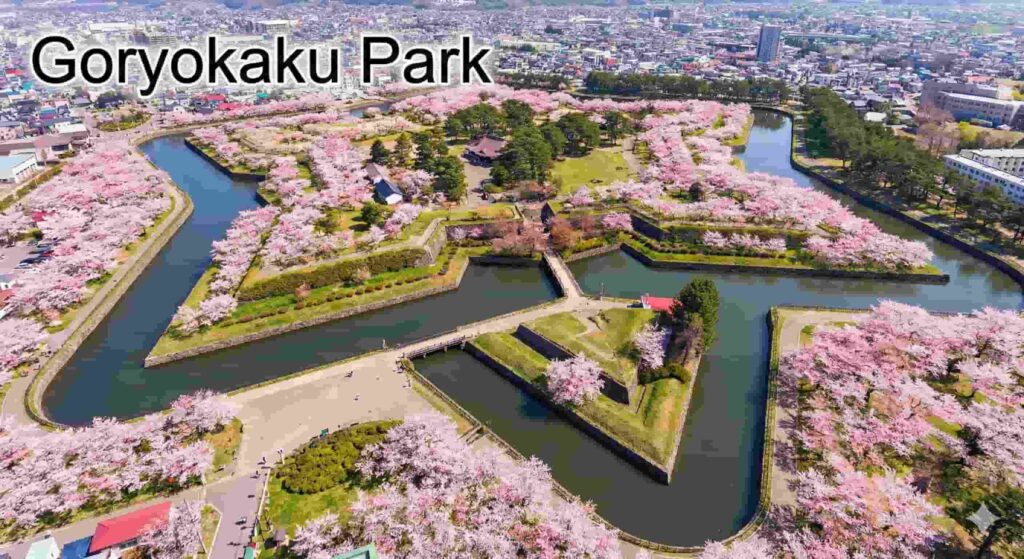
A Star-Shaped Pink Fortress
- Address: 44 Goryokaku-cho, Hakodate, Hokkaido
- Access: 20-25 mins by taxi from Hakodate Airport.
- Map: Google Maps Link
- Best Time to Visit: Late April to Early May
- Key Features: Star-shaped fort, Goryokaku Tower view, Genghis Khan BBQ.
As a special historic site and the stage for the final battles of the Boshin War, Goryokaku is famous for its unique star-shaped (bastion style) architecture. In spring, 1,600 Somei Yoshino trees outline the star in vibrant pink. The definitive way to experience this is from the observation deck of the adjacent Goryokaku Tower. From this vantage point, the pink star creates a geometric marvel unique to this location.
Culturally, Hokkaido locals have a distinct way of enjoying Hanami: they eat Genghis Khan (mutton BBQ). During the season, fire regulations are relaxed, and the smell of savory BBQ mixes with the sweet scent of sakura.
Tohoku Region: The Deep North’s Dramatic Blooms
Tohoku is home to some of the most emotionally moving and technically impressive cherry blossom sites in the world.
3. Hirosaki Park (Aomori)
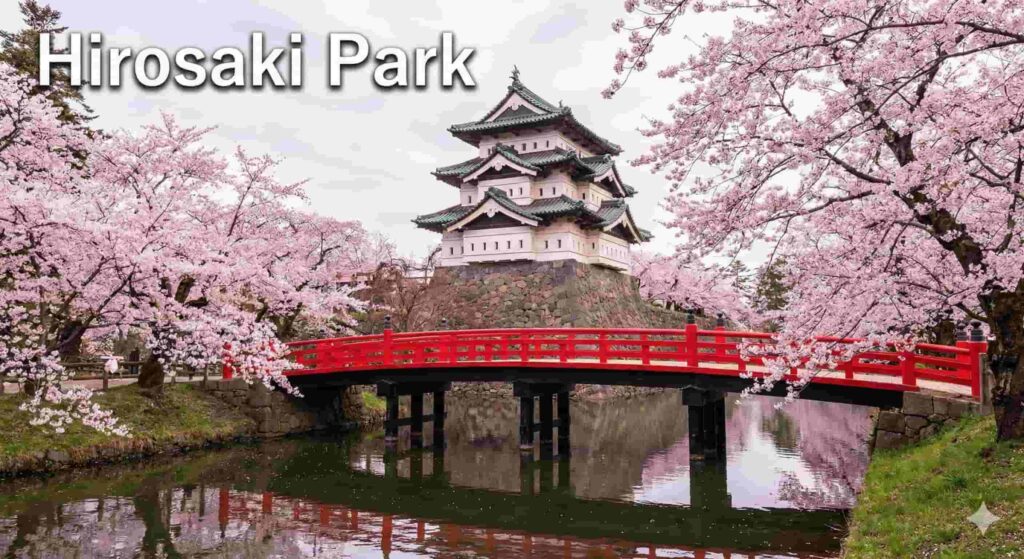
The World’s Best Sakura Management
- Address: 1 Shimoshirogane-cho, Hirosaki, Aomori
- Access: 50-60 mins by car/bus from Aomori Airport.
- Map: Google Maps Link
- Best Time to Visit: Late April to Early May
- Key Features: Floral Rafts (Hanaikada), pruning techniques, Castle views.
Often cited as the single best cherry blossom spot in Japan, Hirosaki Park is a testament to horticultural mastery. Utilizing pruning techniques derived from apple farming, the caretakers here encourage low-hanging, voluminous clusters of flowers that are unmatched elsewhere.
The park features 2,600 trees, including over 300 centenarian Somei Yoshino trees. The absolute highlight is the Hanaikada (Floral Raft), where fallen petals completely carpet the outer moat, turning the water into a flowing river of pink. Combined with the red Gejo Bridge and the castle tower with Mt. Iwaki in the distance, it is a photographer’s dream.
4. Kakunodate Weeping Cherry Trees (Akita)
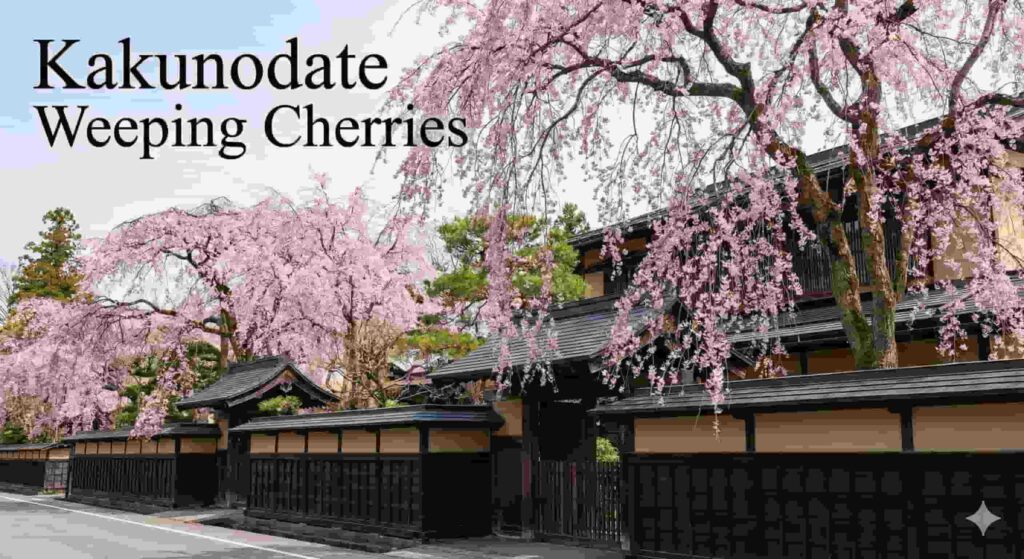
Samurai Elegance and Weeping Willows
- Address: Omote-machi to Higashikatsuraku-cho, Kakunodate-machi, Semboku, Akita
- Access: 50-60 mins by Airport Liner from Akita Airport.
- Map: Google Maps Link
- Best Time to Visit: Late April to Early May
- Key Features: Samurai residences, Shidarezakura (Weeping Cherry), Black walls.
Known as the “Little Kyoto of Michinoku,” Kakunodate offers a distinctively aristocratic atmosphere. The stars here are the Shidarezakura (weeping cherry trees). About 400 of these trees cascade like pink waterfalls against the stark black wooden fences of the ancient samurai residences. 162 of these trees are designated national natural monuments.
Just a short walk away is the Hinokinai River, lined with a 2km tunnel of standard Somei Yoshino trees. This allows visitors to experience the quiet elegance of the samurai district and the dynamic scale of the riverbank in one trip.
5. Miharu Takizakura (Fukushima)
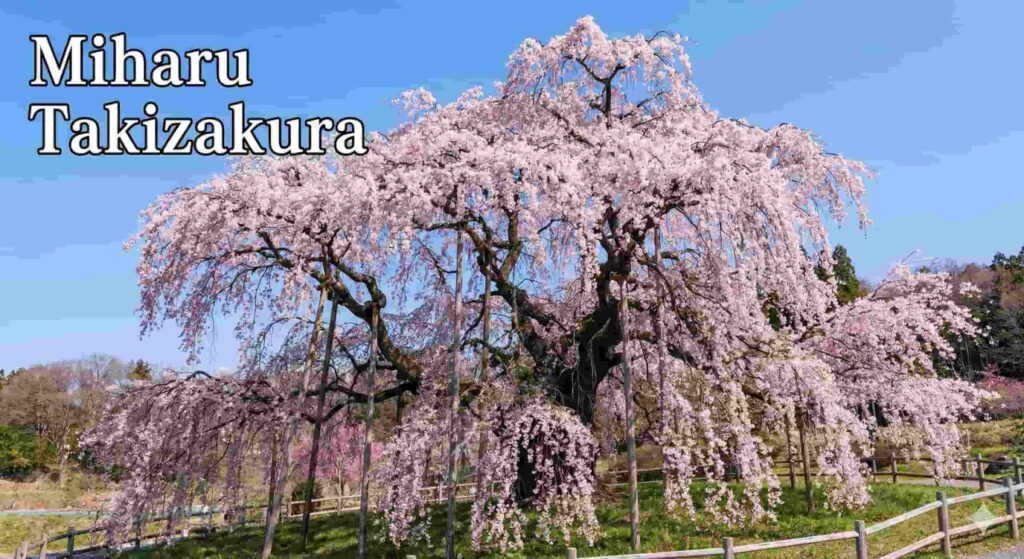
The Waterfall Cherry Tree of the Millennium
- Address: Sakurakubo, Taki, Miharu-machi, Tamura-gun, Fukushima
- Access: 40 mins by car from Fukushima Airport.
- Map: Google Maps Link
- Best Time to Visit: Early to Mid-April
- Key Features: Single ancient tree, over 1,000 years old, National Monument.
While many spots are famous for the number of trees, Miharu Takizakura is famous for one. This single Benishidarezakura is estimated to be over 1,000 years old. It is one of the Three Great Cherry Trees of Japan. Standing 13.5m tall with a root circumference of 11.3m, its branches spread in all directions, creating a cascading “waterfall” (Taki) effect.
Seeing this tree is a spiritual experience. It has survived centuries of history and natural disasters. The tree is lit up at night, creating a ghostly, majestic presence that commands awe.
Kanto Region: Tokyo and Surrounds
Urban sophistication meets traditional beauty. These are the best cherry blossom spots in Japan for those staying near the capital.
Looking to see cherry blossoms around Tokyo? Click here!
・Tokyo’s Best Cherry Blossom Spots: 5 Must-Visit Locations for Spring 2026
・5 Best Cherry Blossom Spots Near Narita Airport
6. Ueno Onshi Park (Tokyo)
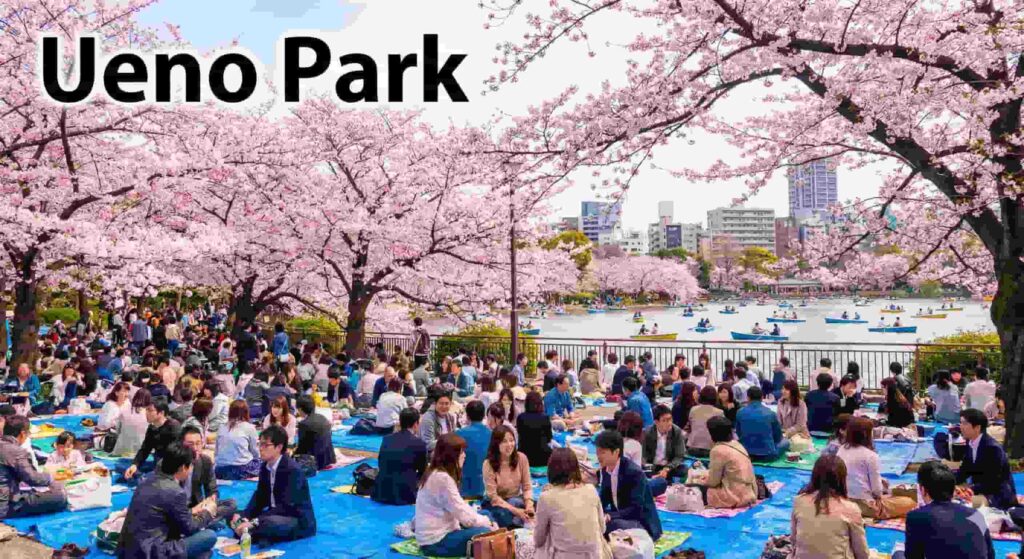
The Center of Tokyo’s Hanami Culture
- Address: Ueno Koen, Taito-ku, Tokyo
- Access: 40-50 mins by train from Haneda Airport.
- Map: Google Maps Link
- Best Time to Visit: Late March to Early April
- Key Features: Lively parties, cultural museums, street food.
Since the Edo period, Ueno Park has been the people’s playground. With roughly 800 trees lining the central pathway, this is the archetypal image of Tokyo Hanami: blue tarps spread on the ground, sake flowing, and joyous crowds. It is loud, busy, and incredibly fun.
The park is surrounded by heavyweights like the Tokyo National Museum and Ueno Zoo, making it a cultural hub. For a quieter experience, head toward Shinobazu Pond, where the reflection of sakura on the water offers a brief respite from the party.
7. Meguro River (Tokyo)
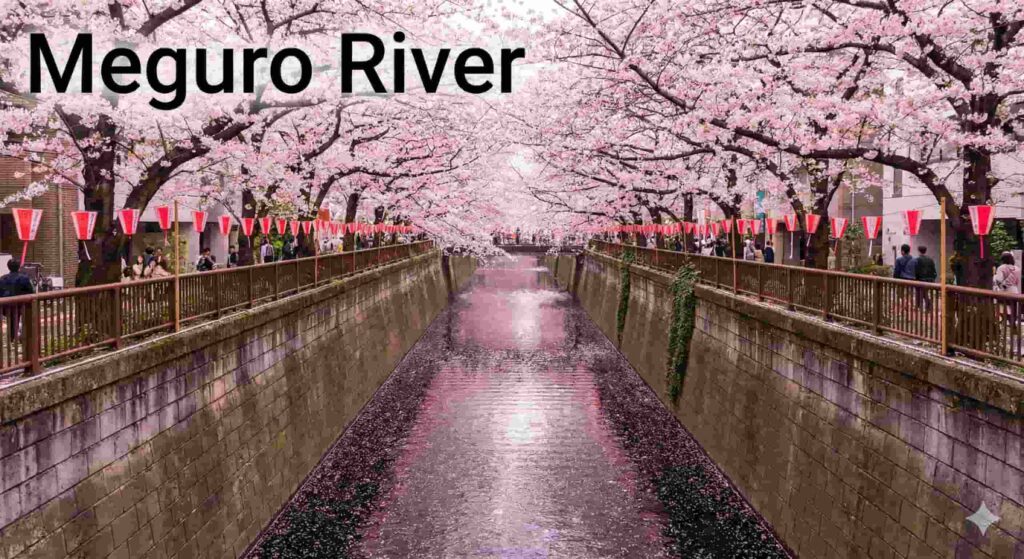
The Stylish Urban Arch
- Address: Ohashi to Shimomeguro, Meguro-ku, Tokyo
- Access: 40-50 mins by train from Haneda Airport.
- Map: Google Maps Link
- Best Time to Visit: Late March to Early April
- Key Features: River canal, Nakameguro cafes, Strawberry sparkling wine.
Spanning 4km with 800 trees, the Meguro River is the most fashionable sakura spot in Tokyo. The narrow canal forces the trees on both banks to reach toward each other, forming a perfect arch over the water.
The Nakameguro area is lined with trendy boutiques and cafes. During the season, it is customary to stroll with a glass of pink sparkling wine or sakura-themed sweets sold by street vendors. The lantern-lit evening view is particularly romantic and sophisticated.
8. Satte Gongendo Cherry Bazaar (Saitama)
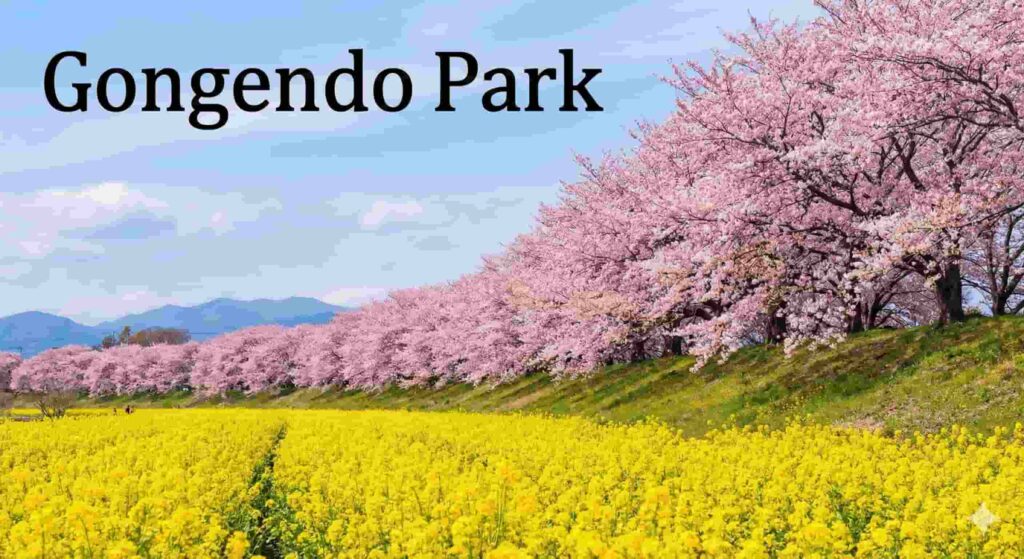
The Pink and Yellow Contrast
- Address: Uchigouma, Satte City, Saitama
- Access: 1.5 – 2 hours by train/bus from Haneda Airport.
- Map: Google Maps Link
- Best Time to Visit: Late March to Early April
- Key Features: Rapeseed flowers (Nanohana), 1km tunnel.
If you are a photographer looking for color, this is your destination. Satte Gongendo is famous for the dual-bloom of 1,000 Somei Yoshino trees on the embankment and vast fields of yellow rapeseed flowers (Nanohana) below.
On a clear day, the composition of blue sky, pink sakura, and yellow flowers creates a vivid tricolor masterpiece. The “Cherry Blossom Tunnel” atop the dike provides a canopy experience, while the view from the bottom offers the famous contrast shot.
Chubu & Hokuriku: Mountains and Castles
Home to the “Three Great Cherry Blossom Spots,” this region offers unique varieties and dramatic alpine backdrops.
9. Takato Castle Ruins Park (Nagano)
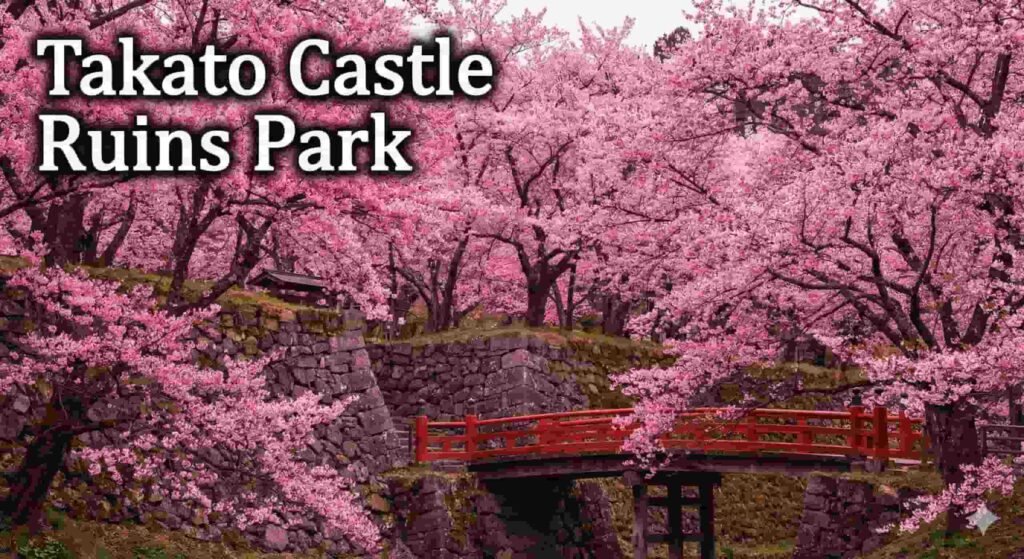
The Cherry Blossom of the First Rank
- Address: Higashitakato, Takato-machi, Ina City, Nagano
- Access: 2.5 – 3 hours from Chubu Centrair Airport.
- Map: Google Maps Link
- Best Time to Visit: Early to Mid-April
- Key Features: Takato Kohigan variety, Japanese Alps backdrop.
Often listed alongside Hirosaki and Yoshino as one of the top three spots in the nation, Takato is unique because of its specific breed: the Takato Kohigan Sakura. These blossoms are smaller but significantly more pink/red than the standard white-ish Somei Yoshino.
When the 1,500 trees bloom, the park looks like it is covered in a deep pink cloud. The view of the snow-capped Central Alps framed by these reddish blossoms is the quintessential image of spring in the Japanese Alps.
10. Takada Castle Site Park (Niigata)
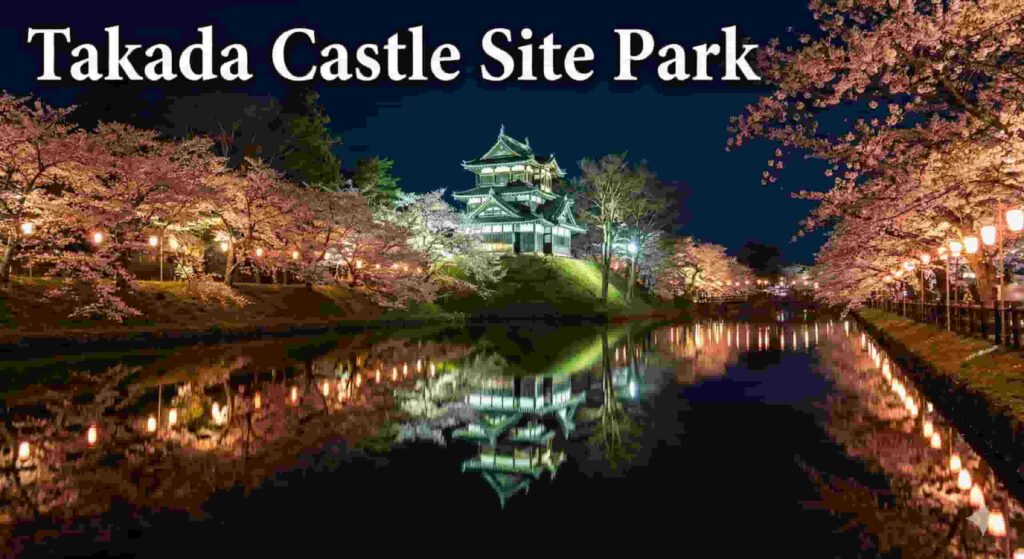
One of Japan’s Three Great Night Sakuras
- Address: 44-1 Motoshirocho, Joetsu City, Niigata
- Access: Approx. 2 hours from Niigata Airport.
- Map: Google Maps Link
- Best Time to Visit: Early to Mid-April
- Key Features: Night illumination, Sakura Road, Triple Turret.
If you prefer evening viewing, Takada Castle is arguably the best cherry blossom spot in Japan for night photography. The park features 4,000 trees illuminated by thousands of bonbori lanterns. The reflection of the illuminated “Sakura Road” and the Triple Turret in the wide moat creates a fantasy-like atmosphere.
11. Kenrokuen Garden (Ishikawa)
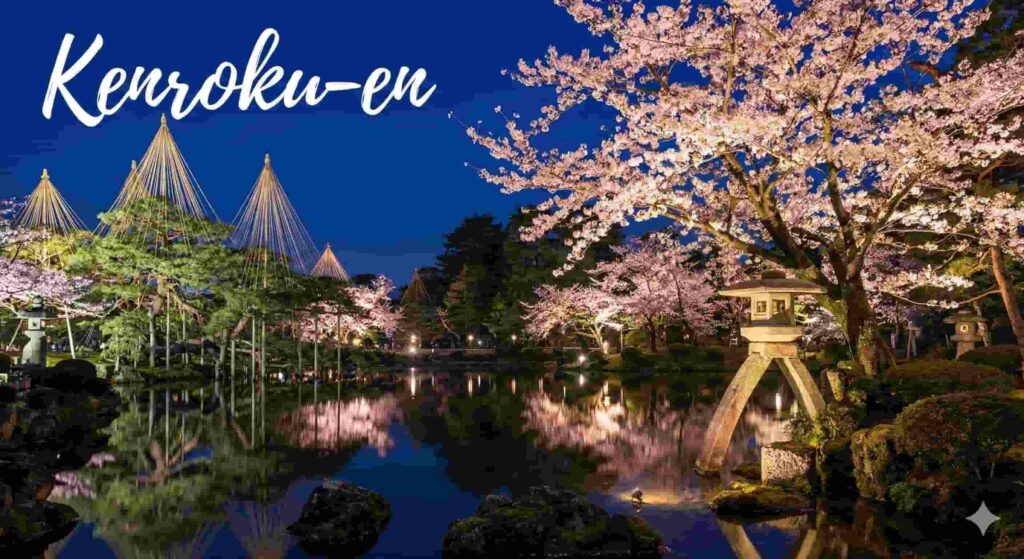
The Height of Japanese Landscape Aesthetics
- Address: 1 Kenrokumachi, Kanazawa, Ishikawa
- Access: 40-50 mins by bus from Komatsu Airport.
- Map: Google Maps Link
- Best Time to Visit: Early to Mid-April
- Key Features: Kenrokuen Kikuzakura, Landscape garden.
As one of the Three Great Gardens of Japan, Kenrokuen offers a refined Hanami experience. It houses rare varieties like the Kenrokuen Kikuzakura, which has over 300 petals per blossom (looking like a chrysanthemum). The harmony between the manicured pines, stone lanterns, winding streams, and the soft sakura is absolute perfection.
12. Kawazu Sakura (Shizuoka)
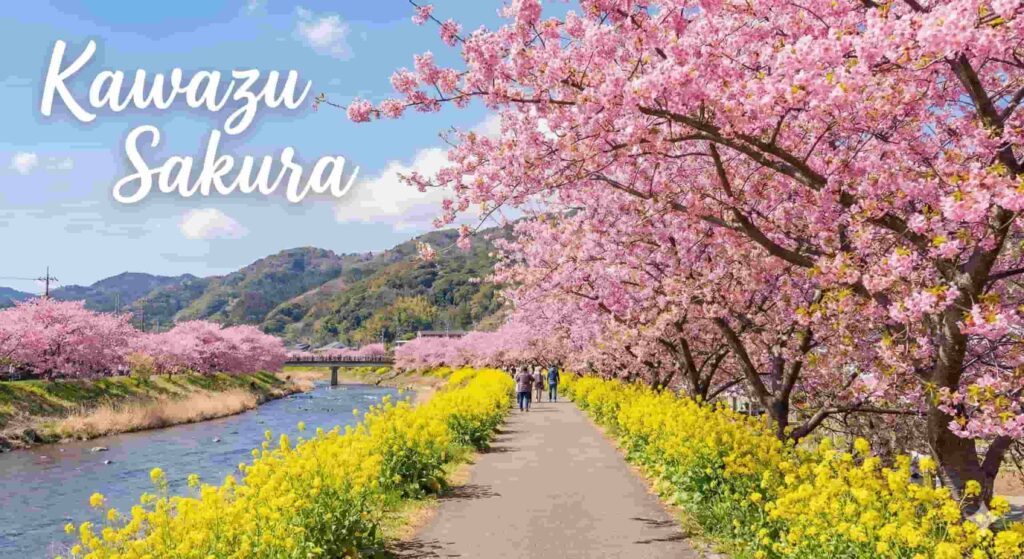
The Harbinger of Spring
- Address: Kawazu-cho, Kamo-gun, Shizuoka
- Access: 2.5 hours by train/car from Mt. Fuji Shizuoka Airport.
- Map: Google Maps Link
- Best Time to Visit: Early February to Early March
- Key Features: Very early blooming, deep pink, long duration.
Can’t wait for April? Head to Kawazu. Famous for the Kawazu Sakura variety, this spot hits peak bloom in February. These flowers are a deep, vibrant pink and last for about a month, unlike the fleeting Somei Yoshino. The 4km stretch along the Kawazu River is also lined with yellow rapeseed flowers, offering an early taste of spring colors while the rest of Japan is still in winter coats.
13. Neodani Usuzumi Zakura (Gifu)
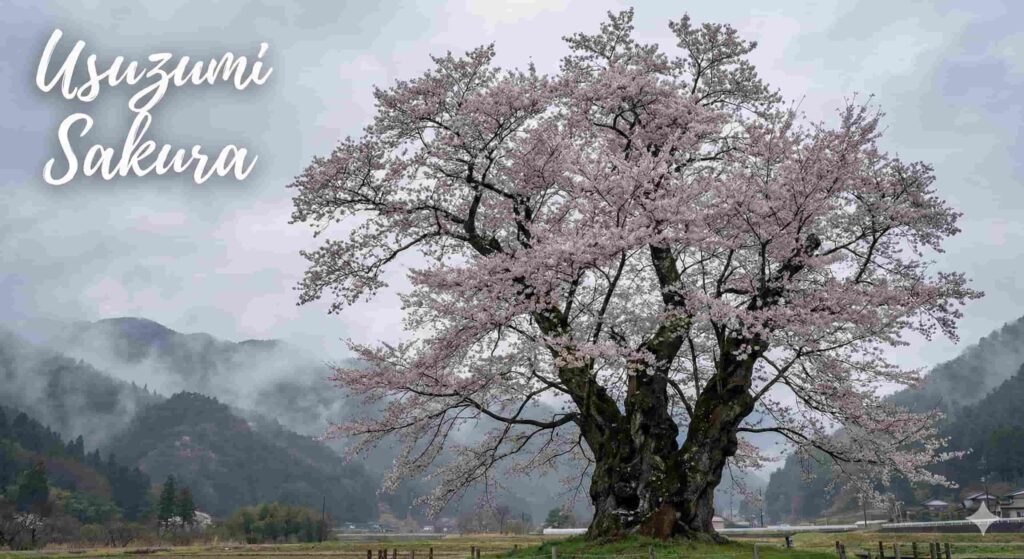
The Grey Cherry of the Ancients
- Address: Neoitasho, Motosu City, Gifu
- Access: 1.5 – 2 hours by car from Chubu Centrair Airport.
- Map: Google Maps Link
- Best Time to Visit: Early to Mid-April
- Key Features: 1,500+ years old, color-changing blossoms.
This is a single tree of immense power. Over 1,500 years old, legend says it was planted by Emperor Keitai. Its name, Usuzumi (Pale Ink), comes from its unique characteristic: the blossoms start pink, turn white at full bloom, and fade to a pale, calligraphy-ink grey before falling. Standing before this tree is a lesson in history and resilience.
Kansai Region: The Historical Heart
Kyoto, Osaka, and Nara host some of the most culturally significant and best cherry blossom spots in Japan.
Looking to see cherry blossoms around Osaka and Kyoto? Click here!
Cherry Blossoms in Osaka and Kyoto: 10 Hanami Spots (2026)
14. Mt. Yoshino (Nara)
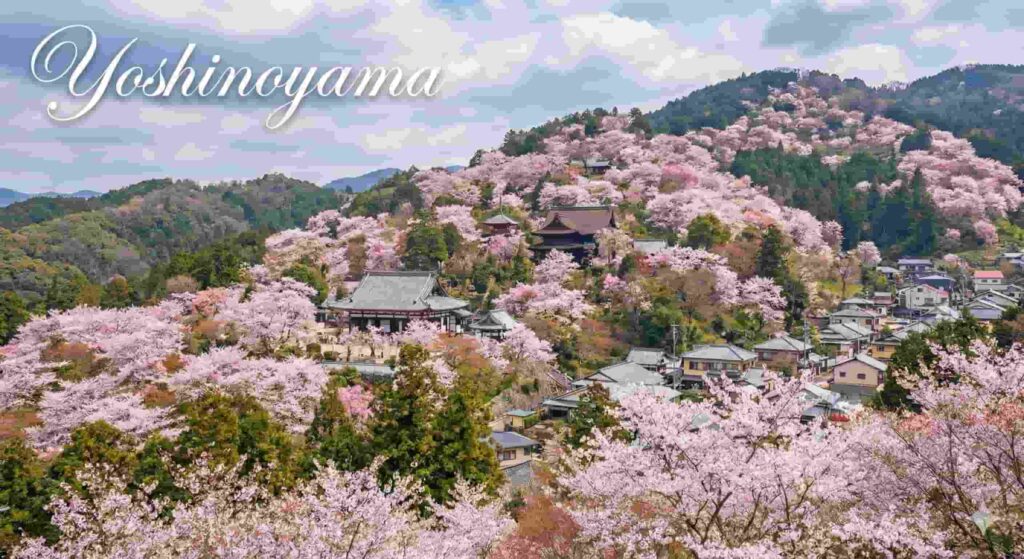
The Mountain of 30,000 Trees
- Address: Yoshinoyama, Yoshino-cho, Nara
- Access: 2 – 2.5 hours by train from Kansai Int’l Airport (KIX).
- Map: Google Maps Link
- Best Time to Visit: Early to Late April
- Key Features: 30,000 trees, UNESCO World Heritage, “Hitome Senbon.”
If there is a king of sakura spots, it is Mt. Yoshino. Covered in approximately 30,000 wild white mountain cherries (Shiroyamazakura), the bloom moves up the mountain in four stages: Shimo (lower), Naka (middle), Kami (upper), and Oku (inner) Senbon.
The term Hitome Senbon means “1,000 trees at a glance.” The scale here is geological; the entire mountainside turns pale pink. It has been a pilgrimage site for emperors and poets for over a millennium.
15. Osaka Castle Park (Osaka)
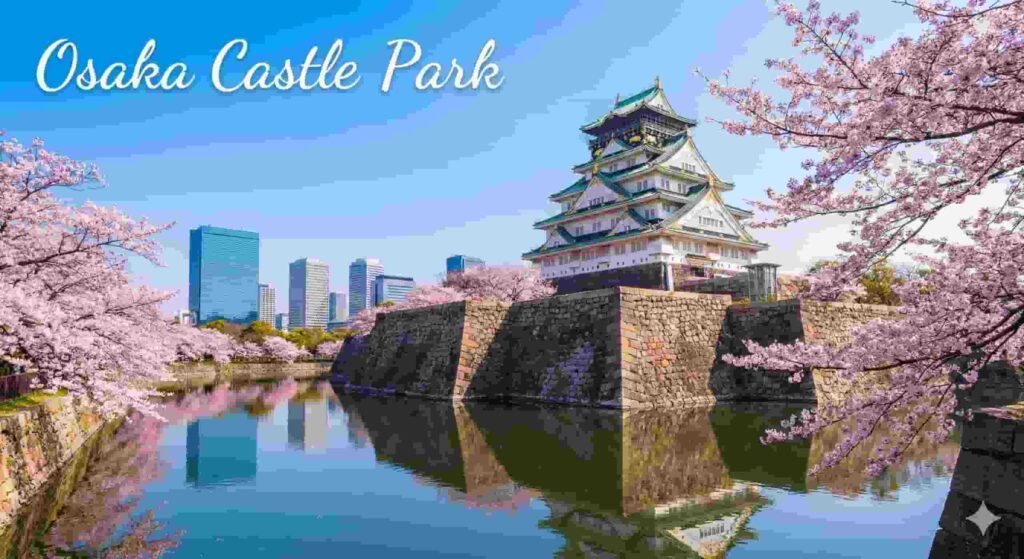
The Symbol of Osaka
- Address: Osakajo, Chuo-ku, Osaka
- Access: 1 hour from KIX.
- Map: Google Maps Link
- Best Time to Visit: Late March to Early April
- Key Features: Nishinomaru Garden, Castle backdrop.
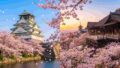
A massive urban park with 3,000 trees. The paid area, Nishinomaru Garden, is the highlight, offering a spacious lawn with about 300 trees and an unobstructed view of the castle tower. It is the perfect spot for a relaxed picnic in the middle of the bustling city. The gold accents of the castle illuminated against the night sakura are stunning.
16. Himeji Castle (Hyogo)
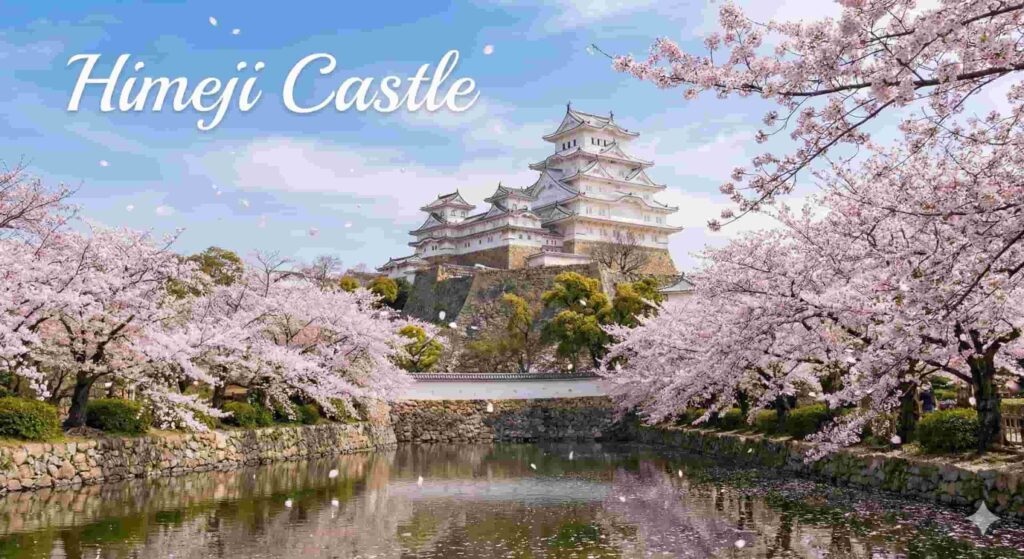
The White Heron and the Pink Cloud
- Address: 68 Honmachi, Himeji, Hyogo
- Access: 1 hour 20 mins from Itami Airport.
- Map: Google Maps Link
- Best Time to Visit: Late March to Early April
- Key Features: UNESCO World Heritage, National Treasure, Pure white castle.
Himeji Castle is Japan’s finest surviving feudal castle. Its brilliant white plaster walls earned it the name “White Heron Castle.” When the 1,000 cherry trees bloom, the contrast between the white walls and the pale pink flowers is widely considered the most beautiful castle scenery in Japan. Taking a traditional boat ride in the moat offers a spectacular lower-angle view.
17. Ninna-ji Temple (Kyoto)
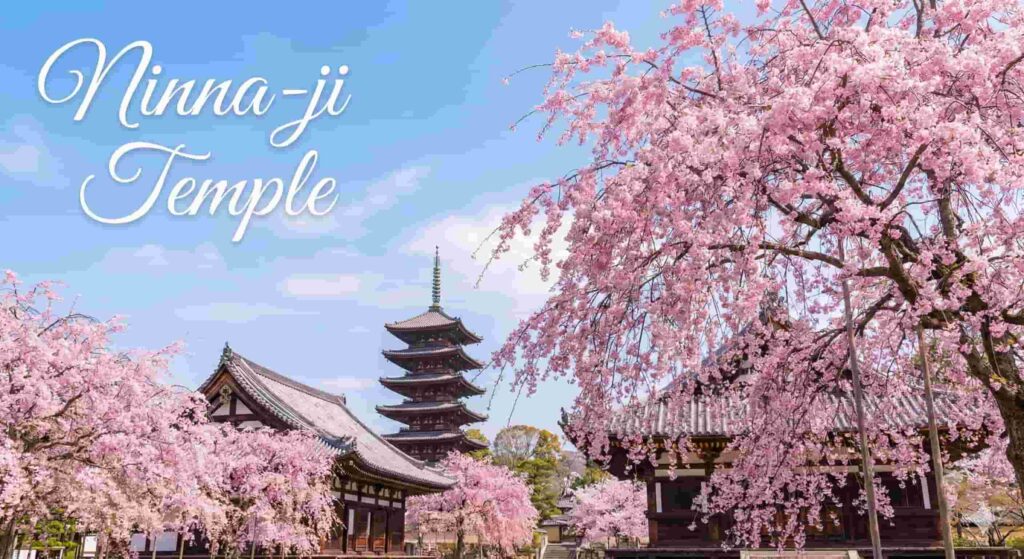
The Late-Blooming Omuro Cherry
- Address: 33 Omuroouchi, Ukyo-ku, Kyoto
- Access: 1 hour from Itami Airport.
- Map: Google Maps Link
- Best Time to Visit: Early to Mid-April
- Key Features: Short trees (Omuro Sakura), Late blooming, Five-story pagoda.
Missed the main season in Kyoto? Go to Ninna-ji. The Omuro Sakura here bloom late. They are famous for being short (about 2-3 meters), allowing you to look down on the blossoms or stand face-to-face with them. The view of the short cherry grove against the Five-Story Pagoda is a classic Kyoto scene.
Chugoku, Shikoku & Kyushu: West Japan’s Gems
Travel further west to discover architectural marvels, coastal views, and some of the most photogenic best cherry blossom spots in Japan.
18. Tsuyama Castle (Kakuzan Park) (Okayama)
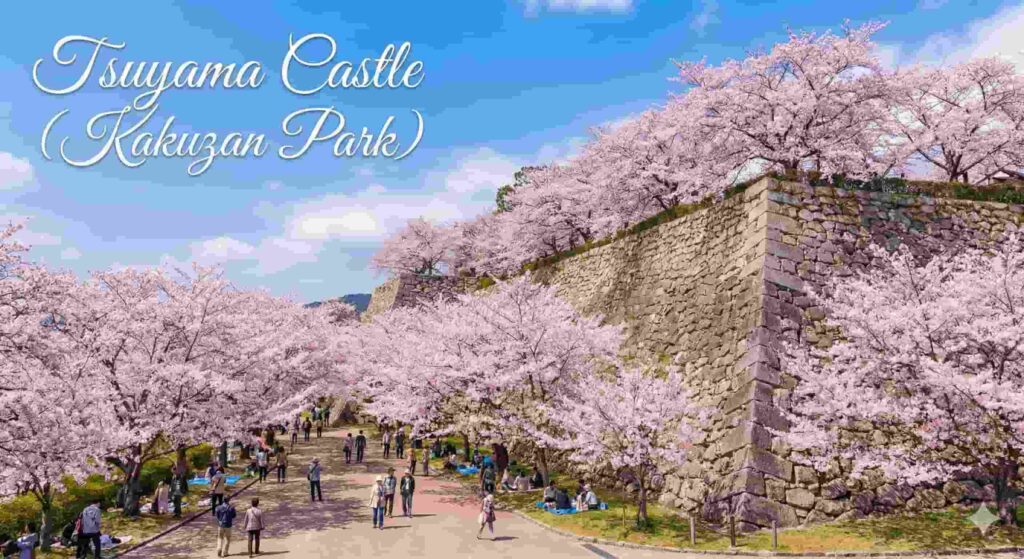
A Sea of Pink Clouds atop Stone Walls
- Address: 135 Yamashita, Tsuyama, Okayama
- Access: Approx. 1 hour to 1 hour 10 mins by car from Okayama Airport.
- Map: Google Maps Link
- Best Time to Visit: Early to Mid-April
- Key Features: 1,000 trees, Bitchu Turret, Stone wall architecture.
Tsuyama Castle, selected as one of Japan’s “Top 100 Cherry Blossom Spots,” offers a viewing experience defined by volume and altitude. Although the original castle structures were dismantled in the Meiji era, the magnificent stone walls remain. Approximately 1,000 cherry trees have been planted among these tiered walls.
When viewed from the top of the stone steps, the density of the blooms creates the illusion of a “sea of clouds” made entirely of sakura. The restored Bitchu Turret (Yagura) floating above this pink sea provides a stunning focal point for photographers. The complexity of the stonework combined with the softness of the blossoms makes this a favorite for castle archeology fans.
19. Kintaikyo Bridge (Yamaguchi)
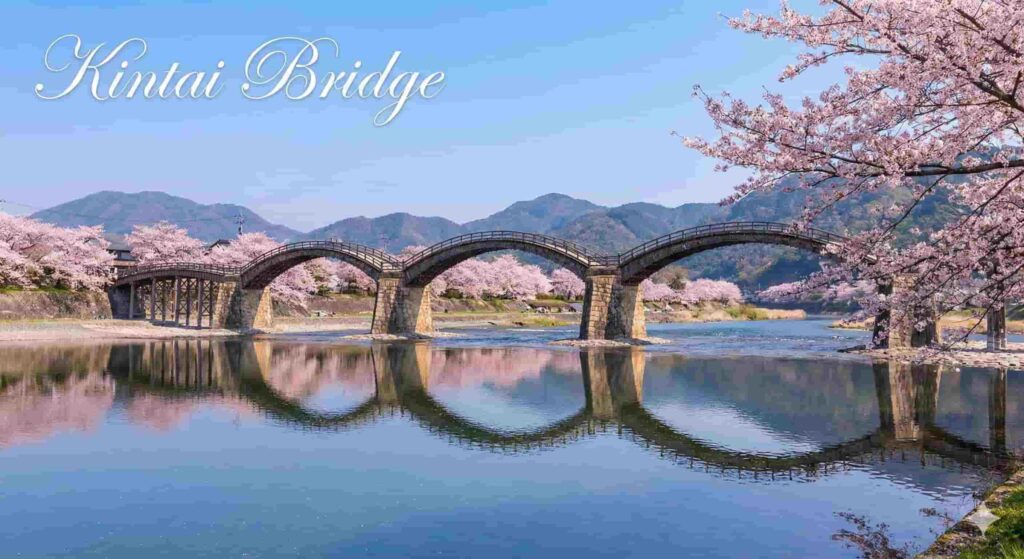
The Golden Arch and the Pink River
- Address: Iwakuni, Iwakuni City, Yamaguchi
- Access: 15-20 mins by car/bus from Iwakuni Kintaikyo Airport (very close).
- Map: Google Maps Link
- Best Time to Visit: Late March to Early April
- Key Features: 5-arch wooden bridge, sightseeing boats, Iwakuni Castle view.
A masterpiece of wooden architecture, the Kintaikyo Bridge is a series of five graceful arches spanning the Nishiki River. It is widely considered one of Japan’s three most famous bridges. In spring, the riverbanks come alive with 3,000 cherry trees (including those in the adjacent Kikko Park).
The visual composition here is flawless: the wooden curves of the bridge, the flowing blue river, the pink cherry tunnel, and Iwakuni Castle perched on the mountaintop in the background. Visitors can enjoy “Sakura Boats” that drift under the bridge, offering a luxurious, low-angle view of the blossoms. At night, the bridge is illuminated in gold, contrasting beautifully with the pale night sakura.
20. Matsue Jozan Park (Shimane)
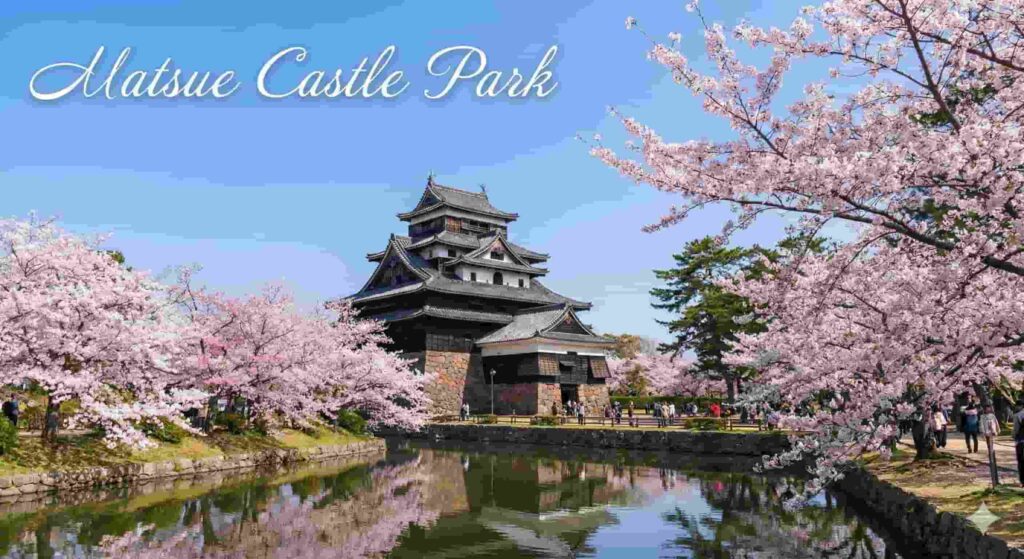
The Black Castle Floating in Sakura
- Address: 1-5 Tonomachi, Matsue, Shimane
- Access: 40 mins by bus from Izumo Enmusubi Airport.
- Map: Google Maps Link
- Best Time to Visit: Late March to Early April
- Key Features: National Treasure Castle, Horikawa Boat Tour, “Black & Pink” contrast.
Matsue Castle is one of only five castles in Japan designated as a National Treasure. Known as the “Plover Castle,” its defining feature is its solemn, black rain-boarding. This creates a striking aesthetic contrast when the 200 Somei Yoshino and Shidarezakura trees bloom—the heavy black wood against the delicate pink flowers highlights the essence of the samurai spirit: strength and fleeting beauty.
The definitive experience here is the Horikawa Sightseeing Boat. These small vessels navigate the castle moat, passing directly under the weeping cherry branches that drape over the water. It is a poetic and immersive way to experience the “City of Water,” Matsue.
21. Ritsurin Garden (Kagawa)
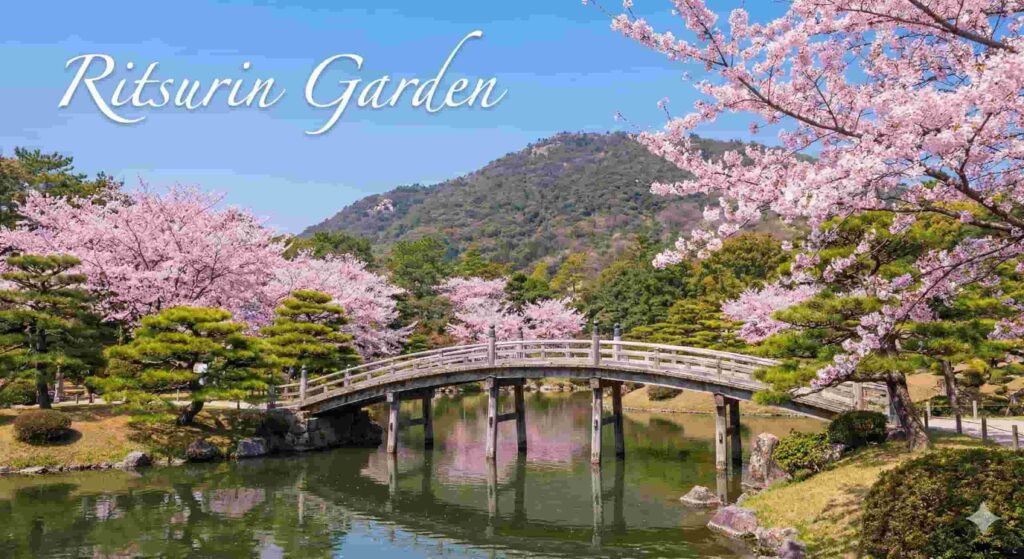
A Michelin-Star Landscape Masterpiece
- Address: 1-20-16 Ritsurin-cho, Takamatsu, Kagawa
- Access: 30-40 mins by bus from Takamatsu Airport.
- Map: Google Maps Link
- Best Time to Visit: Late March to Early April
- Key Features: Pine & Sakura harmony, Lake reflections, Japanese tea houses.
Awarded three stars in the Michelin Green Guide Japan, Ritsurin Garden is a “stroll-style” daimyo garden that prioritizes harmony over volume. Here, the 300 cherry trees are not planted in overwhelming rows but are strategically placed to complement the garden’s famous manicured pines, ponds, and artificial hills.
The deep green of the pines and the pale pink of the sakura create a sophisticated color palette reminiscent of a Japanese painting. The “SCOOP” light-up event in the evening turns the garden into a mystical world, where the mirror-like surface of the ponds reflects the illuminated blossoms in absolute stillness.
22. Matsuyama Castle (Ehime)
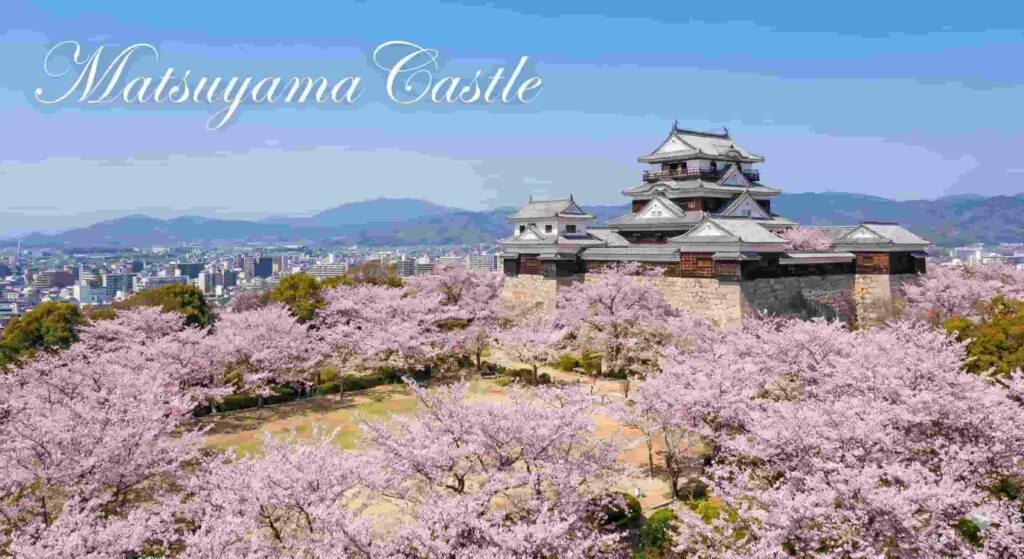
The Aerial Sakura Experience
- Address: 1 Marunouchi, Matsuyama, Ehime
- Access: 30-40 mins by bus/tram from Matsuyama Airport.
- Map: Google Maps Link
- Best Time to Visit: Late March to Early April
- Key Features: Ropeway/Lift access, 360-degree panorama, intricate castle defense.
Perched atop Mount Katsuyama (132m), Matsuyama Castle dominates the city skyline. While you can walk up, the unique draw here is taking the single-chair lift or ropeway. As you ascend, you float through a tunnel of cherry trees on the mountainside—a fun and scenic attraction in itself.
Once at the main citadel (Honmaru), you are greeted by 200 cherry trees and one of Japan’s twelve surviving original keeps. The view is panoramic: you can see the castle, the carpet of cherry blossoms, the city of Matsuyama, and the glittering Seto Inland Sea all in one frame.
23. Kumamoto Castle (Kumamoto)
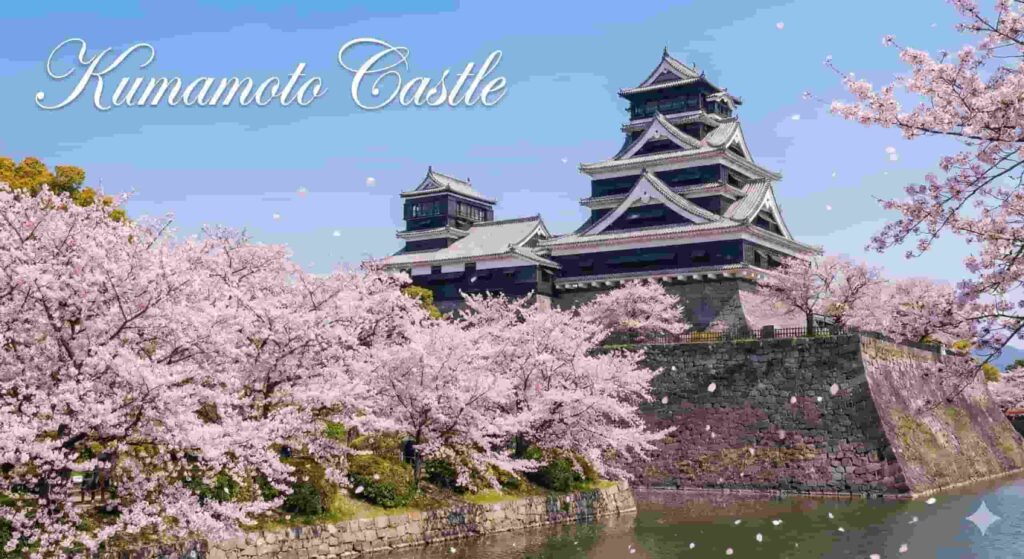
A Symbol of Resilience and Hope
- Address: 1-1 Honmaru, Chuo-ku, Kumamoto City
- Access: 50 mins – 1 hour by bus from Aso Kumamoto Airport.
- Map: Google Maps Link
- Best Time to Visit: Late March to Early April
- Key Features: 800 trees, “Musha-gaeshi” walls, Reconstruction symbol.
Built by the legendary warrior Kato Kiyomasa, Kumamoto Castle is known for its impregnable “Musha-gaeshi” (warrior-repelling) stone walls. Though the castle suffered severe damage in the 2016 earthquake, the main keep has been beautifully restored.
Seeing the 800 cherry trees bloom against the black castle and the backdrop of ongoing reconstruction is a moving experience. The Miyuki-zaka slope offers a dense tunnel of cherry blossoms leading up to the keep. The contrast between the fresh, vibrant flowers and the wounded yet standing stones serves as a powerful metaphor for the region’s recovery.
24. Maizuru Park (Fukuoka)
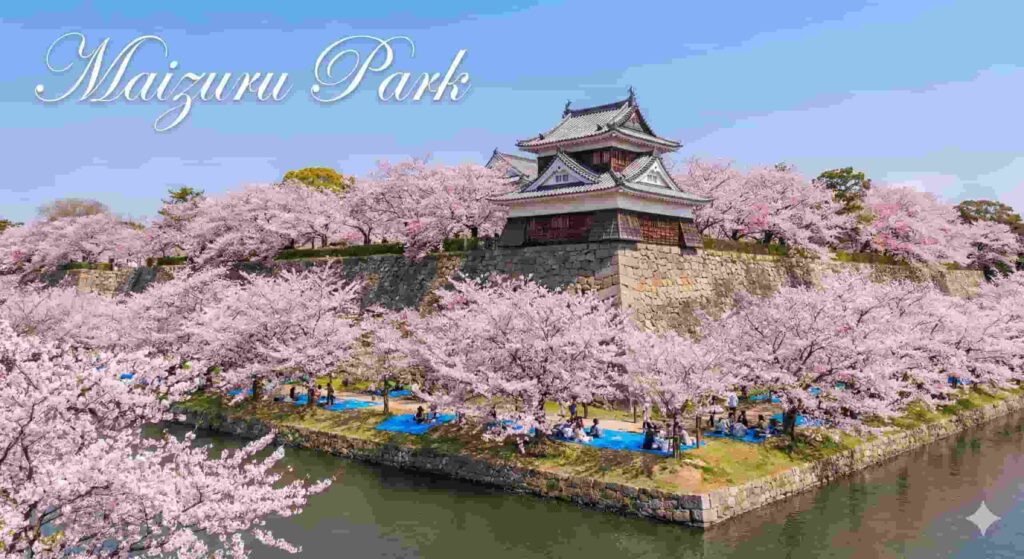
Urban History Meets Modern Art
- Address: 1 Jonai, Chuo-ku, Fukuoka
- Access: 15-20 mins by subway from Fukuoka Airport (extremely accessible).
- Map: Google Maps Link
- Best Time to Visit: Late March to Early April
- Key Features: 1,000 trees, Fukuoka Castle Ruins, Digital Art Festivals.
Located in the heart of Fukuoka City (Tenjin area), Maizuru Park is the site of the former Fukuoka Castle. It is the perfect spot for travelers who want to combine shopping and dining with high-quality Hanami. The park features over 1,000 trees planted among the massive stone walls and moats.
During the Fukuoka Castle Sakura Festival, the ruins are often transformed by teamLab-style digital art and multi-colored illuminations, turning the ancient stone walls into a canvas for modern artistic expression. The view from the Tenshudai (castle keep base) offers a 360-degree skyline of Fukuoka city rising above a forest of pink.
Okinawa: The First Breath of Spring
While the mainland freezes, Okinawa begins the celebration with a tropical twist.
25. Nakijin Castle Ruins (Okinawa)
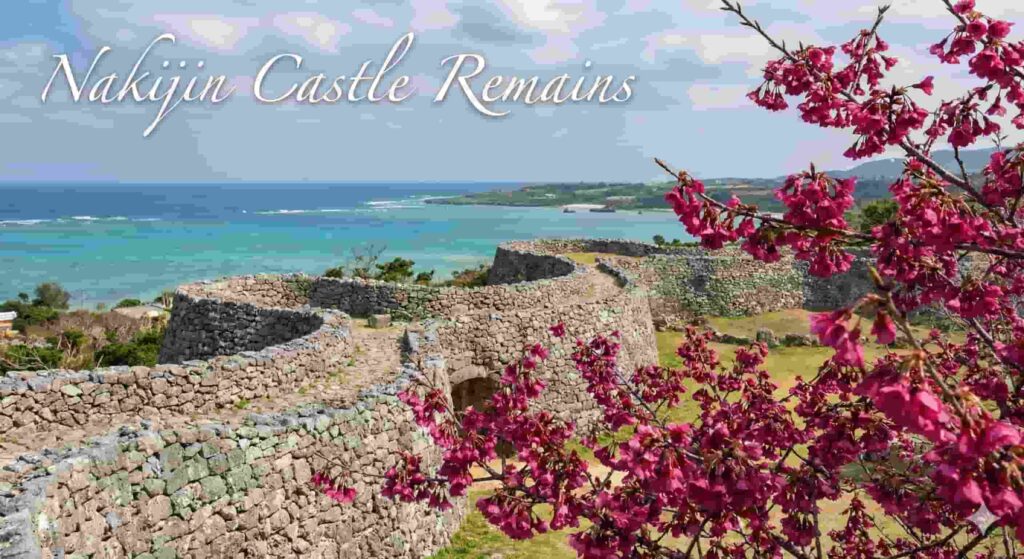
The Earliest Cherry Blossoms in Japan
- Address: 5101 Imadomari, Nakijin Village, Okinawa
- Access: 2.5 – 3 hours by car/highway bus from Naha Airport.
- Map: Google Maps Link
- Best Time to Visit: Late January to Mid-February
- Key Features: Ryukyu Kanhi Sakura, UNESCO World Heritage, Ocean views.
If you are chasing the very first bloom, you must head south. Nakijin Castle, a UNESCO World Heritage site, hosts the earliest Hanami in Japan, often peaking in early February. The cherry trees here are Ryukyu Kanhi Sakura (Taiwan cherry), characterized by their bell-like shape and deep, neon-pink color.
Unlike the fluttering petals of Somei Yoshino, these flowers fall whole, carpeting the ground in red. The sight of these vivid pink flowers lining the curving limestone walls (resembling the Great Wall of China) against the backdrop of the turquoise East China Sea is a unique spectacle found nowhere else. It is a Hanami experience that feels more like a tropical festival than a quiet contemplation.
Conclusion: Crafting Your Perfect Sakura Itinerary
Japan’s cherry blossom season is a transient miracle that captures the heart of every traveler. It is not just about seeing flowers; it is about witnessing a nation unite in appreciation of nature’s fleeting beauty.
From the snow-dusted, late-blooming parks of Hokkaido to the historic, petal-filled moats of Hirosaki, and the vibrant, early-blooming ruins of Okinawa, the best cherry blossom spots in Japan offer infinite variety.
Summary of Regional Timing (2026 Forecast Estimates):
- Okinawa: Late Jan – Mid Feb
- Kyushu / Shikoku / Tokyo: Late March – Early April
- Tohoku (North Honshu): Mid April – Late April
- Hokkaido: Late April – Mid May
Whether you are a photographer chasing the “Sakura Front” or a family looking for a memorable picnic under the trees, these 25 locations represent the pinnacle of the Japanese spring experience.
Next Step
Want to know what to wear for your spring trip to Japan? Check out this article to see Japan’s spring temperatures!