












You’ve finally arrived in Japan. You’ve navigated the trains, found the hidden alleyway, and are standing in front of a legendary ramen shop. The smell of simmering pork bones and soy sauce is intoxicating. But there’s a problem.
Between you and that life-changing bowl of broth stands a formidable gatekeeper: The Ticket Machine (Shokkenki).
It is covered in buttons. It is exclusively in Japanese. There is a line of hungry salarymen forming behind you, and you can feel the pressure mounting. Do you panic and press a random button? Do you walk away?
Not today.
This guide is your passport to dining confidence. We are going to deconstruct the ramen ticket machine, decode the essential Kanji, and teach you the secret language of customization that separates the tourists from the pros. By the end of this article, you won’t just be ordering ramen; you’ll be commanding the kitchen.
Related Posts
[The ‘Otoshi’ Trap: Why You Got an Appetizer You Didn’t Order at Izakaya]
[Stop Tipping! Why it’s Actually Rude in Japan (And What to Do Instead)]
- Why Do Ramen Shops Use Ticket Machines?
- The Golden Rule: Money First, or Button First?
- Decoding the Machine Layout: Where is the “Good Stuff”?
- The Essential Kanji Glossary for Ramen Toppings
- Advanced Customization: The “Call”
- The “Kaedama” Trap: Are You Still Hungry?
- Troubleshooting: When The Machine Beeps at You
- Ramen Shop Etiquette: Do’s and Don’ts
- The “Jiro” Challenge: A Warning
- Conclusion: Embrace the Ticket Machine
Why Do Ramen Shops Use Ticket Machines?
Before we dive into the “how,” it helps to understand the “why.” You might wonder why a restaurant with staff would force you to transact with a vending machine.
The Japanese food ticket machine is a marvel of efficiency. In the high-paced world of ramen, speed is everything.
- Hygiene: Cooks don’t have to touch dirty cash and then handle your noodles.
- Speed: Orders are often relayed to the kitchen the moment you purchase the ticket, drastically reducing wait times.
- Focus: It allows the master (Taisho) to focus entirely on the craft of soup-making rather than counting change.
Understanding this shifts your perspective: The machine isn’t a barrier; it’s the first step in the ritual of a high-quality meal.
The Golden Rule: Money First, or Button First?
This is the most common stumbling block for beginners trying to order ramen in Japan.
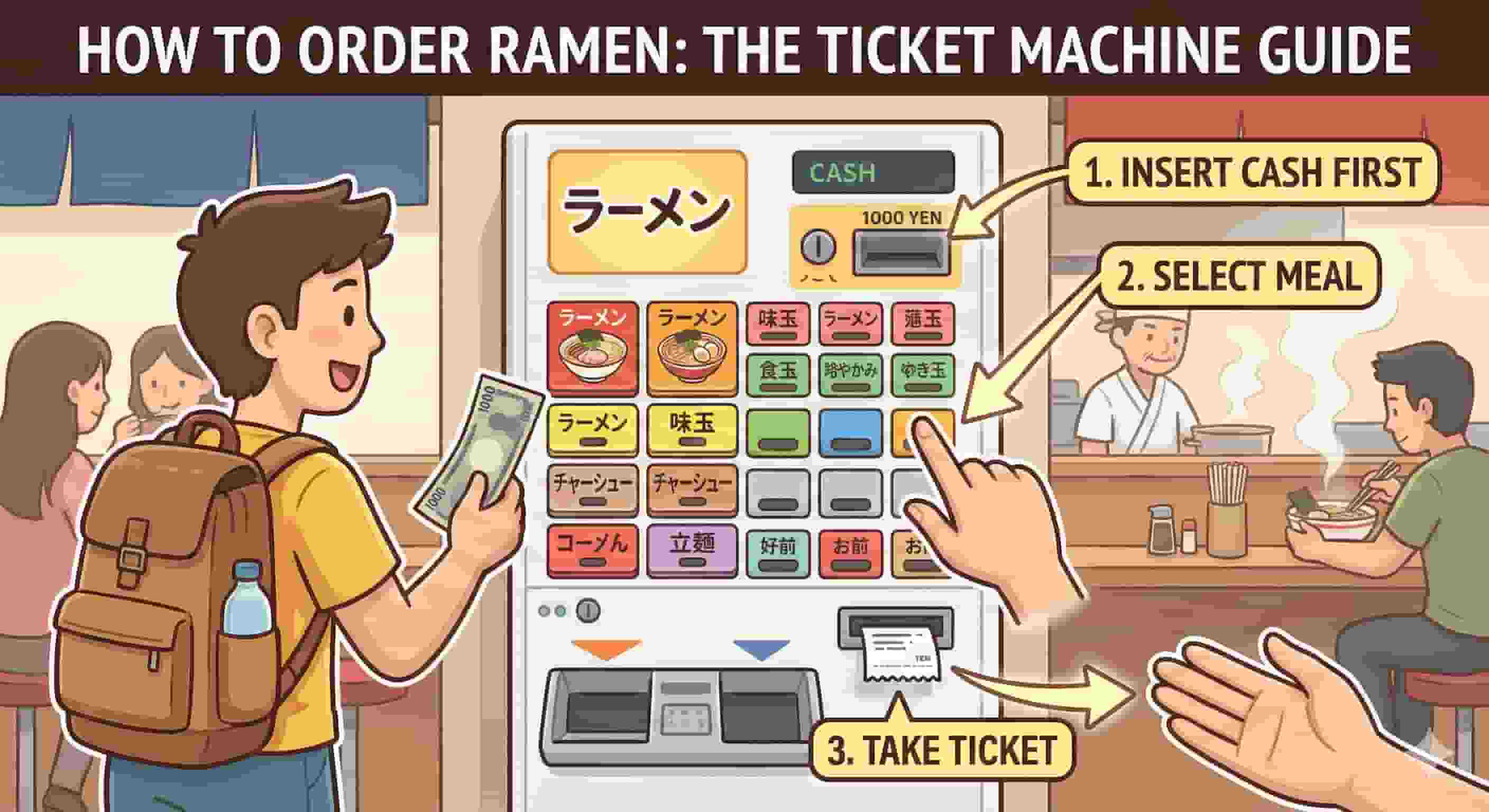
In Western vending machines, you often make a selection and then pay. In Japan, roughly 90% of ramen ticket machines require you to insert money first.
The Universal Step-by-Step Flow:
- Insert Cash: Put your 1,000 yen bill or coins into the designated slots.
- Watch the Lights: The buttons will light up (usually red, yellow, or blue) once enough money is inserted to afford them.
- Make Your Selection: Press the button for your main dish, then any toppings or drinks.
- Get Your Change: Pull the lever or press the “Otsuri” (Change) button. Do not forget this step!
- Collect Tickets: Take the small paper tickets that pop out.
- Enter and Seat: Hand the tickets to the staff and sit down.
Pro Tip: Most older machines only accept 1,000 yen bills and coins. If you only have a 10,000 yen note, look for a separate bill changing machine nearby, or ask the staff by showing your large bill and saying “Ryogae onegaishimasu” (Exchange, please).
Decoding the Machine Layout: Where is the “Good Stuff”?
While every shop is different, ramen vending machine translation becomes easier when you recognize the standard psychological layout used by shop owners.
The “Z” Pattern
Designers of these machines know that the human eye scans in a “Z” pattern, starting at the top left.
- Top Left (The Flagship): The top-left button is almost always the shop’s signature dish (The “Osusume”). If you are completely lost, press the top-left button. It is the safest bet for the best experience.
- Top Row: Usually variations of the main dish (e.g., with extra egg, extra meat, or a large size).
- Middle Rows: Different flavors (e.g., switching from Shoyu to Miso) or side dishes like Gyoza and Rice.
- Bottom Rows: Drinks (Beer/Cola) and individual topping add-ons.
The Essential Kanji Glossary for Ramen Toppings
You don’t need to be fluent in Japanese, but memorizing a few shapes will save you from ordering a bowl of plain noodles when you wanted a feast. Here is your cheat sheet for ramen toppings kanji.
The Main Broths
- ラーメン (Ramen): The standard dish.
- 豚骨 (Tonkotsu): Pork bone broth (creamy, white).
- 醤油 (Shoyu): Soy sauce broth (brown, clear).
- 塩 (Shio): Salt broth (light, yellowish/clear).
- 味噌 (Miso): Bean paste broth (rich, opaque).
- つけ麺 (Tsukemen): Dipping noodles (noodles served cold on the side of hot soup).
The Toppings
- 味玉 (Ajitama): Marinated soft-boiled egg. Essential.
- チャーシュー (Chashu): Braised pork belly slices.
- メンマ (Menma): Bamboo shoots.
- ネギ (Negi): Green onions.
- 海苔 (Nori): Dried seaweed sheets.
- 全部のせ (Zenbu-nose): “All toppings included.” This is the deluxe version.
Portion Sizes
- 並 (Nami): Regular size.
- 大盛 (Omori): Large size (more noodles).
- 小 (Sho/Hanhun): Small/Half size.
Advanced Customization: The “Call”
Buying the ticket is only half the battle. When you hand your ticket to the chef, they may bark a question at you. Do not panic. They are asking for your preferences.
To order ramen like a pro, you need to know how to customize your bowl. This is especially common in Iekei (Yokohama style) and Hakata (Tonkotsu) shops.
1. Noodle Firmness (Men no Katasa)
The chef may ask “Men no katasa wa?” (How hard do you want the noodles?)
- Yawarakame: Soft.
- Futsuu: Normal/Regular.
- Katamen: Firm. (Recommended for most ramen).
- Barikata: Very firm (Common in Hakata style).
- Harigane: Wire-hard (For experts only).
2. Soup Richness (Aji no Kosa)
- Usume: Light/Less salty.
- Futsuu: Normal.
- Koime: Strong/Salty.
3. Oil Amount (Abura no Ryo)
- Sukuname: Less oil.
- Futsuu: Normal.
- Oome: More oil/Rich.
The “Magic” Phrase: If you are overwhelmed, just smile and say “Futsuu de” (Normal, please). It works 100% of the time.
The “Kaedama” Trap: Are You Still Hungry?
If you are eating Tonkotsu ramen (like at Ichiran or Ippudo), you might finish your noodles but still have delicious broth left. Do not drink the soup yet!
This is time for Kaedama (noodle refill).
- How to order: Usually, you can buy a ticket for this at the machine beforehand, or buy it with cash at your seat.
- The Etiquette: Wait until you have finished your first batch of noodles. Raise your hand or press the call button and say “Kaedama onegaishimasu.”
- The Rule: Never order Kaedama if you have finished your soup. You need the hot soup to warm up the fresh noodles.
Troubleshooting: When The Machine Beeps at You
Even veterans encounter errors. Here is how to handle ramen vending machine translation errors.
- Scenario A: The machine spits your bill back out.
- Fix: The bill might be wrinkled. Smooth it out against the edge of the machine. If it persists, the bill might be an old series or damaged. Try a different note.
- Scenario B: The button won’t light up.
- Fix: Check the “Sold Out” lamp. If a red light labeled 売切 (Urikire) is lit on the button, that dish is gone for the day. You must choose something else.
- Scenario C: You bought the wrong ticket.
- Fix: Take the ticket and immediately hand it to the staff while saying “Machigaemashita” (I made a mistake). They will usually refund you in cash so you can buy the correct one.
Ramen Shop Etiquette: Do’s and Don’ts
To truly blend in and respect the culture, follow these unspoken rules of Japanese ramen shop etiquette.
1. Don’t linger
Ramen is fast food. It is meant to be eaten while hot. Chatting for 30 minutes after you finish eating while people are waiting in line is considered rude. Eat, enjoy, and leave.
2. Slurping is Good
Slurping cools the noodles and aerates the broth, enhancing the flavor. It is not rude; it is a compliment to the chef.
3. Counter Discipline
- Water: It is almost always self-service. Look for a pitcher on the counter or a water dispenser near the entrance.
- Tray Return: If you are sitting at a counter, once you finish, lift your bowl and wipe the counter with the provided rag. Place the bowl on the high ledge above the counter. This tells the chef “Thank you, I am done.”
![Image Alt Text: A steaming bowl of Tonkotsu ramen with chashu pork, soft boiled egg, and nori, sitting on a wooden counter next to a glass of water.]
The “Jiro” Challenge: A Warning
There is a specific sub-genre of ramen called Ramen Jiro. These shops are famous for massive portions and a cult-like ordering syntax.
If the ticket machine has yellow plastic tokens, you might be at a Jiro-style shop. The chef will ask “Ninniku wa?” (Garlic?).
This is a trap. He isn’t just asking about garlic; he is opening the floor for you to declare your toppings.
- Yasai: Vegetables (Bean sprouts).
- Abura: Back fat.
- Karame: Soy sauce.
You must reply with the amount:
- Sukuname: Little.
- Mashi: Extra.
- Mashimashi: Double extra.
Example Response: “Yasai mashimashi, ninniku, abura.” (Double vegetables, garlic, and fat).
Note: Only attempt this if you have a massive appetite. Leaving food behind at a Jiro shop is a major faux pas.
Conclusion: Embrace the Ticket Machine
The ticket machine is not a barrier; it is a gateway to culinary bliss. It represents the efficiency and dedication to craft that makes Japanese dining so special.
By mastering the ramen ticket machine guide, understanding the key ramen toppings kanji, and knowing your personal preferences for noodle firmness, you transform from a confused tourist into a savvy diner. The anxiety vanishes, replaced by the anticipation of that perfect, steaming bowl.
So, walk up to that machine. Put your money in first. Press that top-left button with confidence. The best meal of your trip is waiting just on the other side.
Ready to Eat?
Now that you’ve mastered the machine, you need to know where to go.
- Check out our guide to the [ Top 10 Hidden Ramen Shops in Tokyo].
- Need help with other foods? Read our [Sushi Etiquette Guide for Beginners].
External References & Further Reading:
- Tabelog Japan – The ultimate authority on Japanese restaurant rankings.
- Japan National Tourism Organization (JNTO) – Dining Guide
- Ramen Beast – An app and resource for finding high-quality ramen in Japan.